Courts, crimes, marriage, food, dress and a day in Tharax
Law
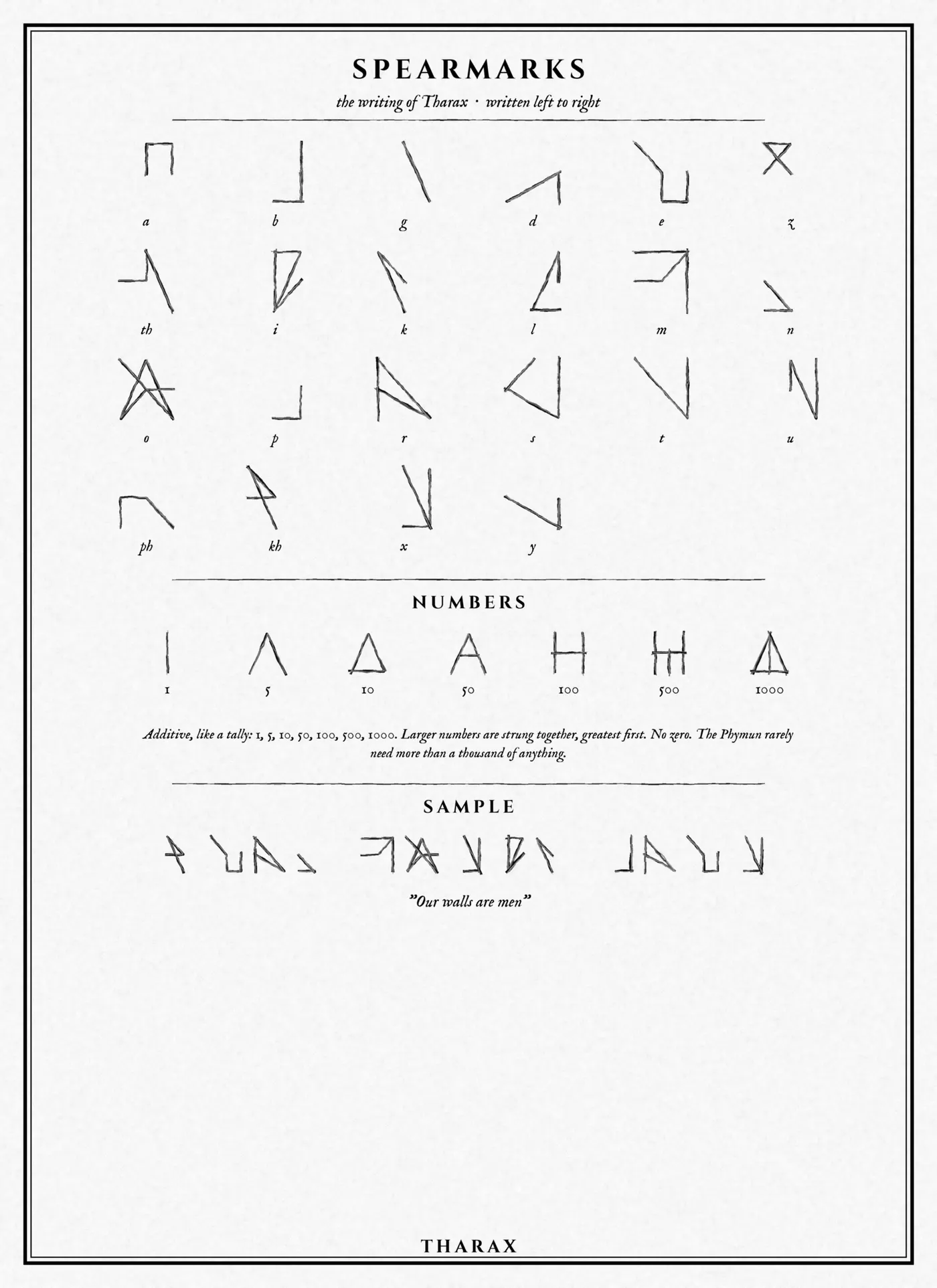
Tharax has almost no written law. The Phymun hold that writing is for treaties with people who cannot be trusted, so their law is custom kept in the memory of the Thirty. The two kings lead in war and share the rule. The Thirty, elders over sixty, decide matters of state, judge every capital case and serve as Kharnoth's priests. The five Skekar, elected each year and seated on Wardens' Day, the 1st of Lokok, oversee everything else, and they can arrest a king. The senior skekir names the year and heads the Tyrthas. In 1146 that is Sirtys Gonamik, a widow of fifty-eight. A Phymon woman can be elected skekir, though no woman sits among the Thirty.
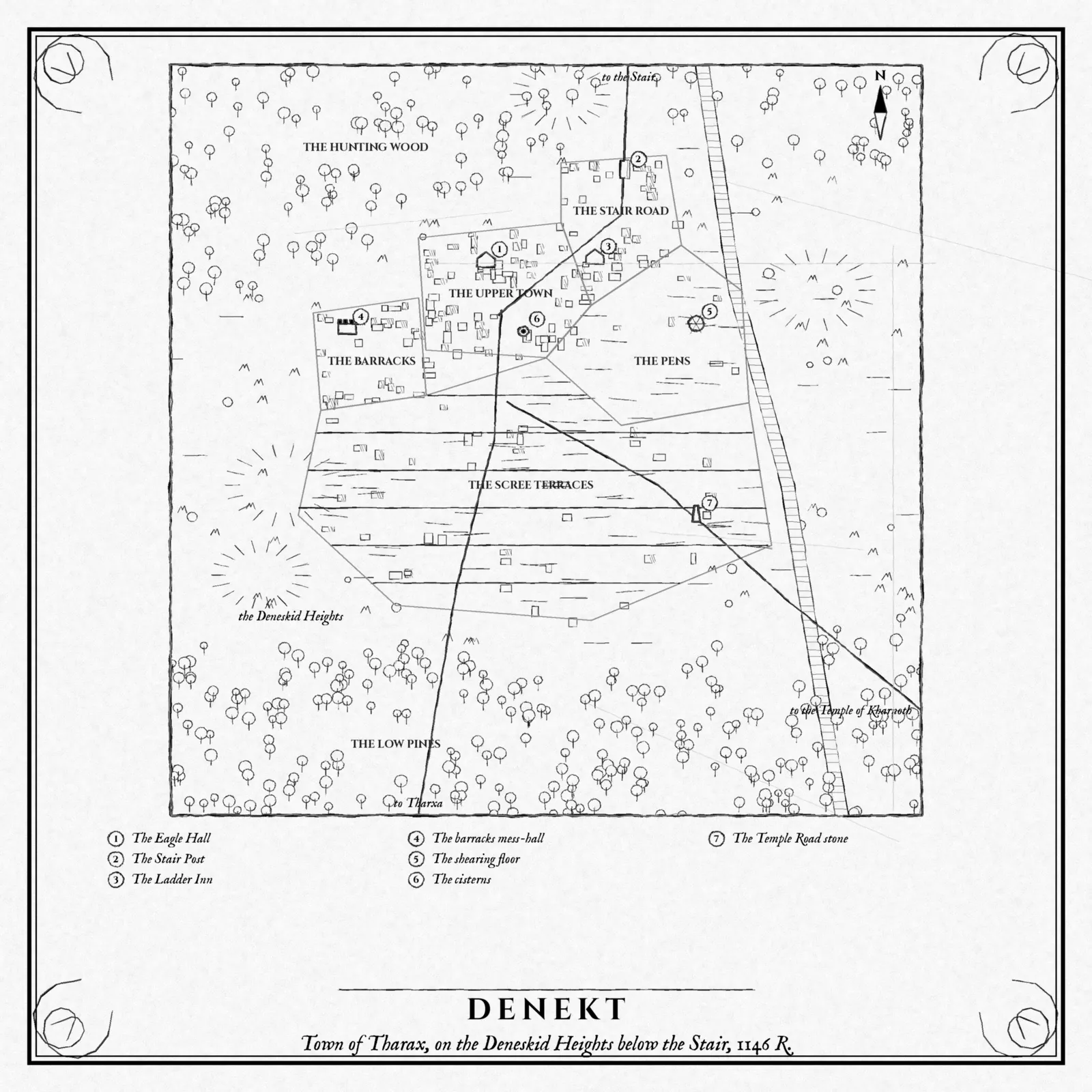
Phymun answer to the Skekar, and the Road Watch, drawn from the mess-halls one hall to each ten days, brings disputes before them. Outdwellers answer to the Skekar through the eldest of each craft yard. The Bound answer to the Tyrthas, the secret watch founded after the First Bound Rising of 199. A foreigner found asleep outside a Strangers' Yard is walked back the first time and thrown out the second.
| Crime |
Usual punishment |
| A Phymon who shames his hall |
Eats standing at the mess for a set number of tens |
| A Phymon who steps back in the line |
Stripped of his red cloak and eats outside the daipox for a year |
| A Phymon found holding gold |
Tried by the Thirty; King Phospor died in prison for it in 741 |
| An Outdweller hoarding foreign coin |
The coin forfeit to the Gold House and a fine in iron bars |
| A Bound servant carrying a knife in Tharxa |
Flogged (the rule dates from 520) |
| A Bound runaway, caught |
Flogged and returned; a second flight is hanged |
| A Bound who reads, keeps the Furrow or strikes a Phymon |
Hanged, and the body left on the Warning Posts |
| Killing a Phymon |
Death, by judgment of the Thirty |
Outlawry and debt. Short of death, the worst that can befall a Phymon is to lose his seat at the mess. Every citizen's household sends a share of barley, cheese and iron to his daipox, and a man whose household cannot send it for a full year is struck from the hall and becomes, in law, an Outdweller. Debt is therefore the women's business, since they own the land and keep its tallies. Money is the iron bar, the nisox, scored in ten, and foreign gold belongs to the state. Nobody needs to be banished from Tharax. The Bound go over the Stair by night, and a Phymon who takes Caelvenne's pay or a foreign wife is spoken of in the past tense.
Family
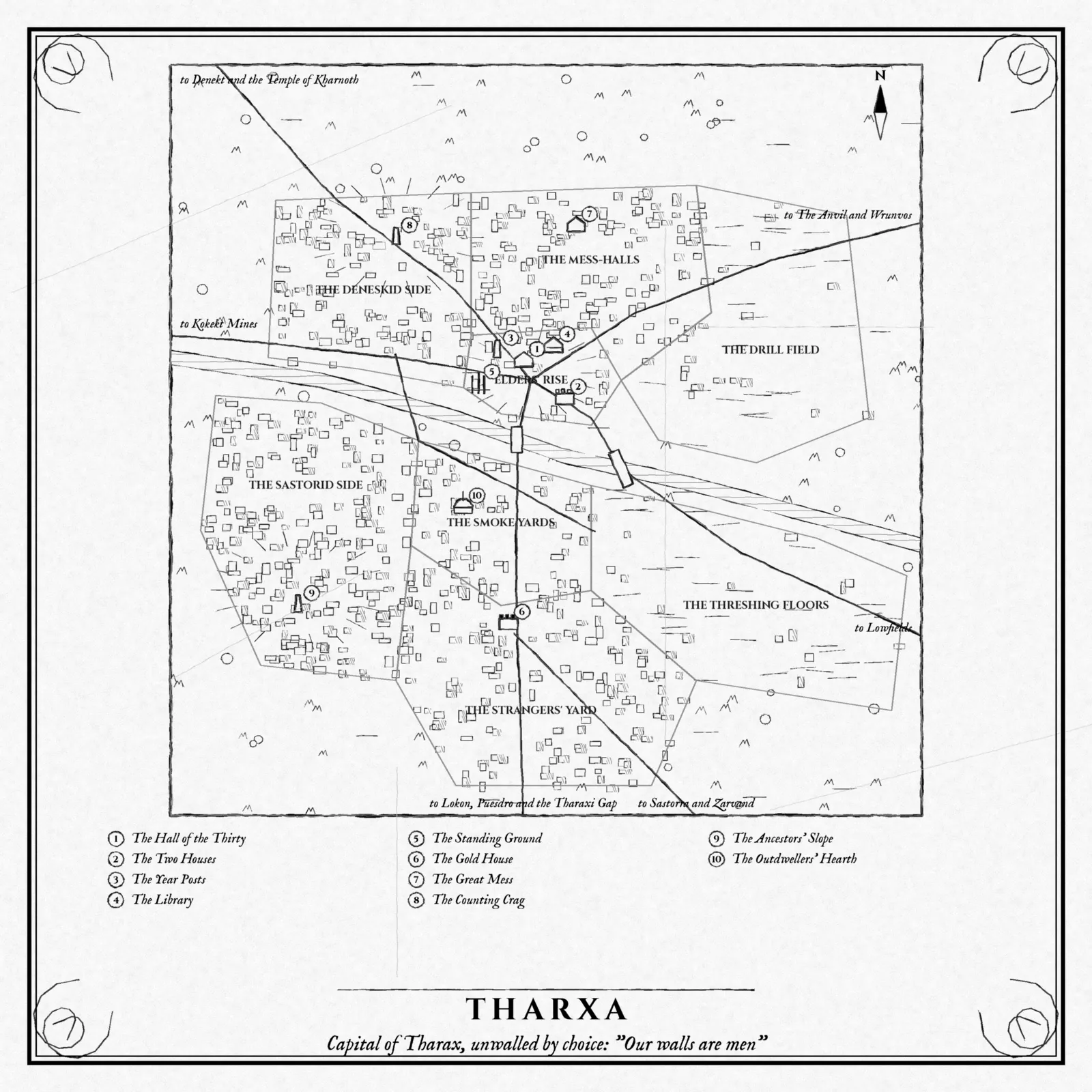
Marriage. Mothers arrange marriages, and a bride wears crag edelweiss. Phymon men under thirty sleep in the mess-halls, so a young husband visits his wife by night and is back for the morning drill. The house, the goat-yard and the terraces belong to the wife. She may send her husband back to his hall for good by setting his spear outside her door, and the Skekar will not hear his complaint. A husband has no such power, and the Skekir's Wife is the story of why.
Inheritance. Phymon land passes from mother to daughter, which is why the women own most of Tharax. A son inherits his father's spear, shield and seat in the hall. When a king dies, the Thirty choose the next from the grown men of his own line.
Women. Phymon women own the land, hold the purse of the realm and keep accounts on tally-boards that nobody counts as writing. Phymon girls train in the Anvil and are branded like the boys, but they live in their mothers' houses and do not fight in the line, which Krirtys Sastorid wants to change. The few who speak for the Iron Contract's gold are mostly women, because they are the ones who count it.
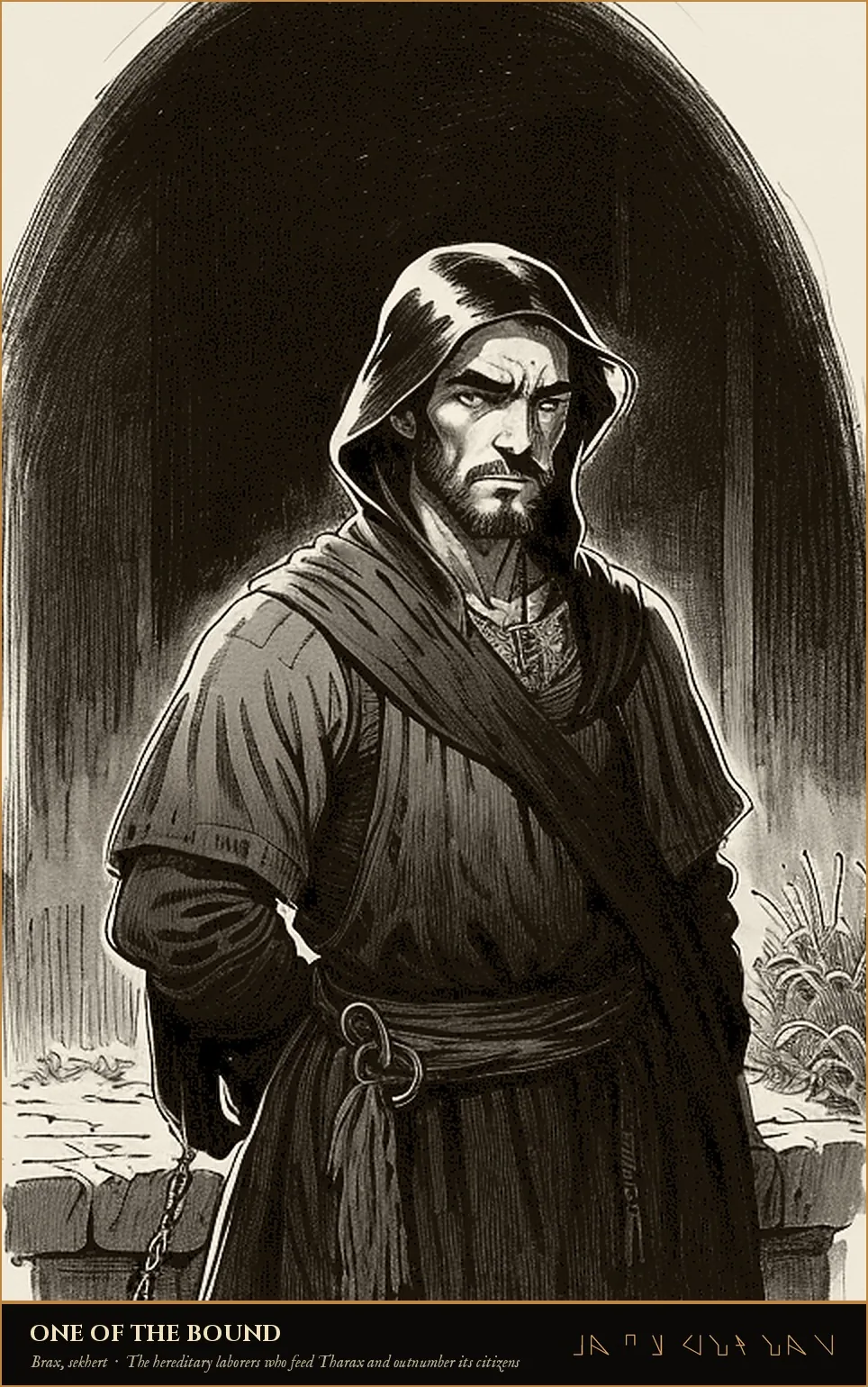
The Bound. The Bound are born to labor, and they far outnumber their masters. A Bound family belongs to the terraces it works. When the land passes, the Bound pass with it. No Phymon may sell a Bound family off its land or kill one without showing cause to the Skekar, though the Tyrthas needs no cause. In the same summer that a Phymon child of seven takes the spear-point brand on the shoulder, a Bound child of seven takes a plain bar on the back of the neck (tokhekh, "brand"). The Bound marry among themselves with the landholder's leave, and their children are Bound. They may not read, carry a knife in Tharxa or keep the Furrow. Each Bound village has a headman, and the senior skekir knows every one of their names. They speak their own field-talk, dasthax. They rose in 199 and 520, and a third rising in 938 was betrayed before it began.
Outdwellers are free but not citizens. They make everything the Phymun need, marry as they like, own their workshops and, since the Reforms of 1108, may send their sons to the Anvil.
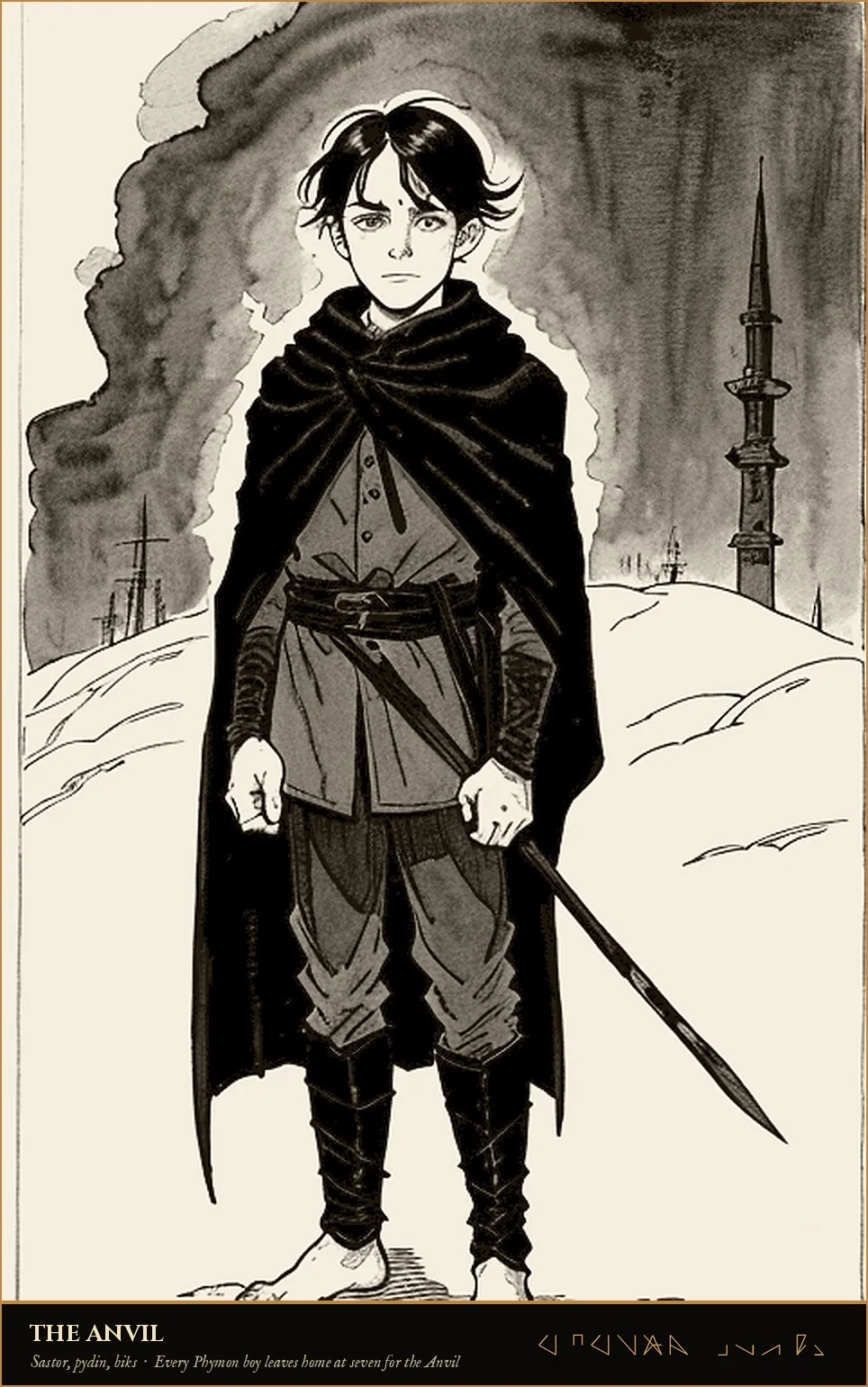
Children and schooling. A Phymon boy leaves home at seven for the Anvil. There he is branded without a sound and hears the Boy Who Would Not Cry on his first night. He learns the order of battle, the spear, the ibex hunt and the bear rite, and perhaps one Phymon in ten learns to read. Bound children go to the terraces at six. A Phymon mother pinches her baby when it smiles, because a child who laughs before one will not survive the Anvil.
Daily life
Food and drink. Tharax eats barley, goat and sheep. Wine is for foreigners.
|
A Phymon man in the mess-hall |
A Phymon woman at home |
A Bound family |
| Morning |
Nothing before drill; black barley bread after |
Barley bread, goat's milk, cheese |
Barley porridge, whey |
| Midday |
Bread and goat cheese on the Drill Field |
Bread, cheese, whatever the yard gives |
Bread and onions on the terrace |
| Evening |
Mutton-and-barley broth with Anvil thyme, Spine sheep, snow grouse or Kokekt char in season, ale |
Broth, cheese, headwater trout in season |
Barley broth, a snared snow grouse in winter, the leftovers of the Empty Chair |
Dress and houses. Phymon men wear red cloaks dyed with ibex-lichen, women wear red at feasts, and nobody wears gold. Everyone wears coarse Spine wool and hobnailed boots, and the Bound's undyed collars show the bar on their necks. Phymon houses are stone below and timber above, with a walled goat-yard and pine-shingle roofs weighted with stones. The Bound live in fieldstone huts at the terrace ends, or in the back rooms of the houses they serve.
Health and hygiene. Anvil boys wash in snowmelt all year, and warm water is thought a foreign habit. Wounds are dressed with crushed Anvil thyme and bad stomachs with Gap gentian root. All the learning in physic Tharax owns is a few Zarvani books taken in war. Among the Bound the old women keep the herb-lore, and the Tyrthas pays them little mind, which suits the Furrow's Sowers. Stonebane, the purple monkshood of the high meadows, is said to be the Tyrthas's tool when a death must look like fever.
Birth and death. A Phymon child is named by its mother on the tenth day. The Phymun bury their dead in rows on the Ancestors' Slope, facing the city, each with an iron bar in his hand, and kings lie at the top with a Karzhan eagle feather. The Bound bury their dead without markers at the terrace ends, and a Sower scratches a furrow on the underside of the first stone laid over the grave.
Pastimes. Tharax runs, wrestles, throws the javelin, hunts with Gap falcons and tells stories. It has no bells and few songs, because its armies fight in silence. The Bound sing field-songs in dasthax, and the Tyrthas listens to them carefully.
A day. The companies are on the Drill Field before the sun clears the ridge, and the Bound are already on the terraces. At dusk the men go to their mess-halls and the women count the day at home. The week is a ten of numbered days from kaim to dakt, and on dakt every hall eats together.
Where it is going: CONTESTED. Tharaxi law was made to keep sixty thousand men equal and everyone else in their places, and it is failing at both. The citizens grow fewer, the Outdwellers' sons are in the Anvil, the Bound can see the Stair, and the gold the law says has a smell has paid for Tharax's steel since 1131. Something in Tharaxi custom will have to be written down soon, and whoever holds the brush will decide what it says.
Trade, taxes and money
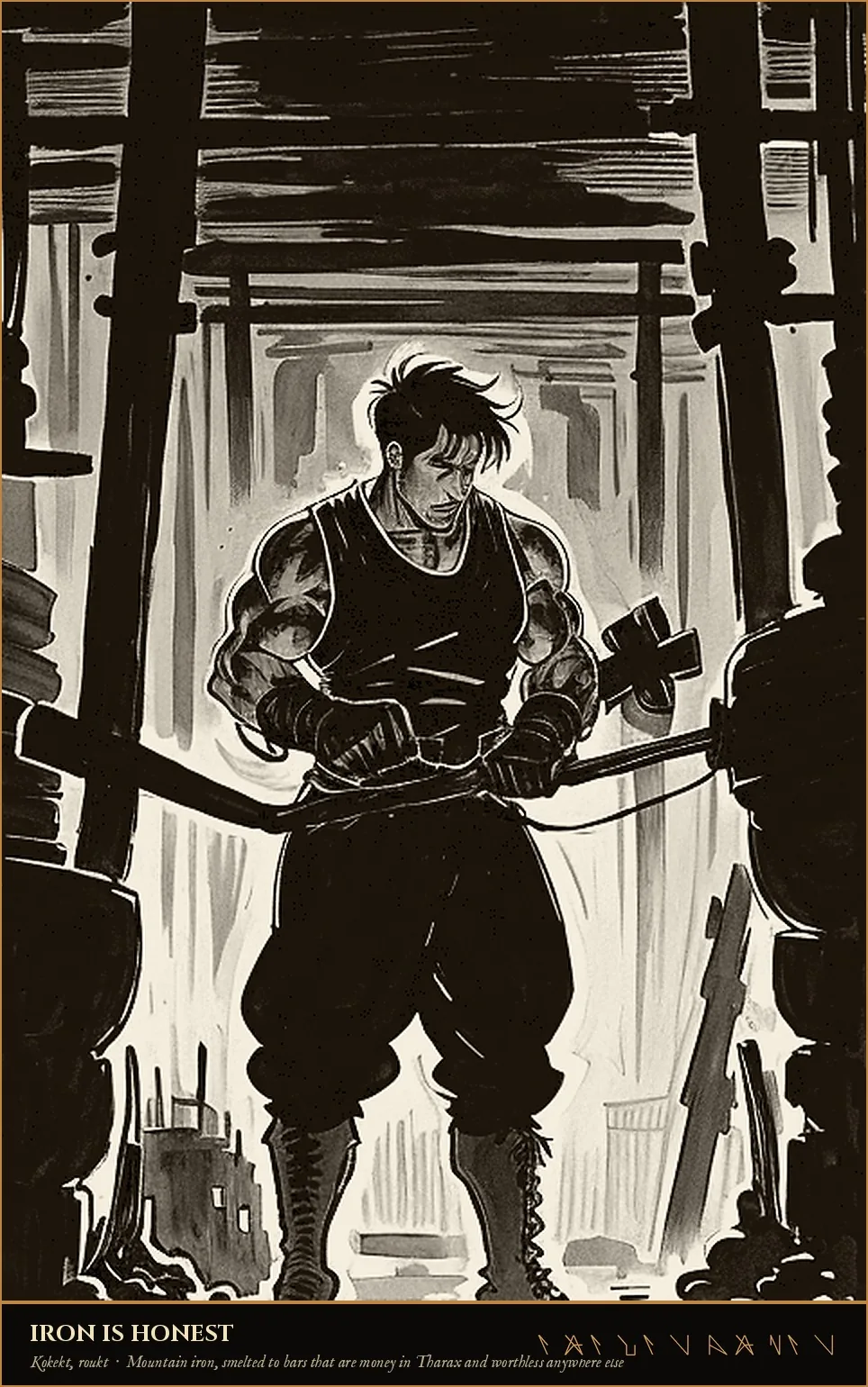
Makes and sells. Barley, goats, cheese and coarse wool, all worked by the Bound; Kokekt iron, hides and Gap falcons, sold only through the Strangers' Yard. Its one great export is its army.
Buys. Salt, which it cannot make; Dunmorrow steel for spear-points and breastplates; grain and Aldmere wool in bad years; wine for the foreigners in the Yard.
Money and taxes. The only lawful money inside Tharax is the iron bar of the Bar Forge, and no Phymon may hold gold. The state takes what it needs in kind:
- Each Phymon household sends its mess-share, a fixed measure of barley, cheese and meat, to its man's mess-hall every month. The Bound grow it.
- Outdweller craft yards pay a craft levy in bars or finished work, set by the Skekar each year.
- Foreigners pay by the Gold House rate of two marks to the bar, which is a tax in all but name, and a Yard fee of a tenth of a bar a night for every beast. At Lokon, caravans pay a pass toll of one bar a beast for the Gap road.
The Gold House lives on the Iron Contract's 100,000 leusores. By the tally of Sithaks the Tally-Keeper it spends about 45,000 a year on Dunmorrow steel, 10,000 on salt, 20,000 on grain in a middling year, and the rest on mules, cart horses and the Yard's business. In 1146 it holds about 135,000 leusores in reserve: three years of steel.
Direction. CONTESTED. The gold ends in 1147, and the only thing Tharax has ever sold abroad is itself.