Every people of the One Land has heard of two men, and no people can bring them to the table. I keep the Sitting's roll. The roll is where men come to be counted, and these two have never come. So I have gone about it the other way. I have asked every envoy and every clerk, every boatman at the landing and every Qaflan driver who would stop long enough, what his people tells of the Two. What follows is what they told me: what the Two are called in each tongue, the tales, what each faith has decided to do about them, where they are said to have sat, and what the rolls can say and what they cannot.
None of it is sworn. All of it is older than the things that are. I have written it as it was told, and I have not said whether it is true, because no one has ever given me the means to.
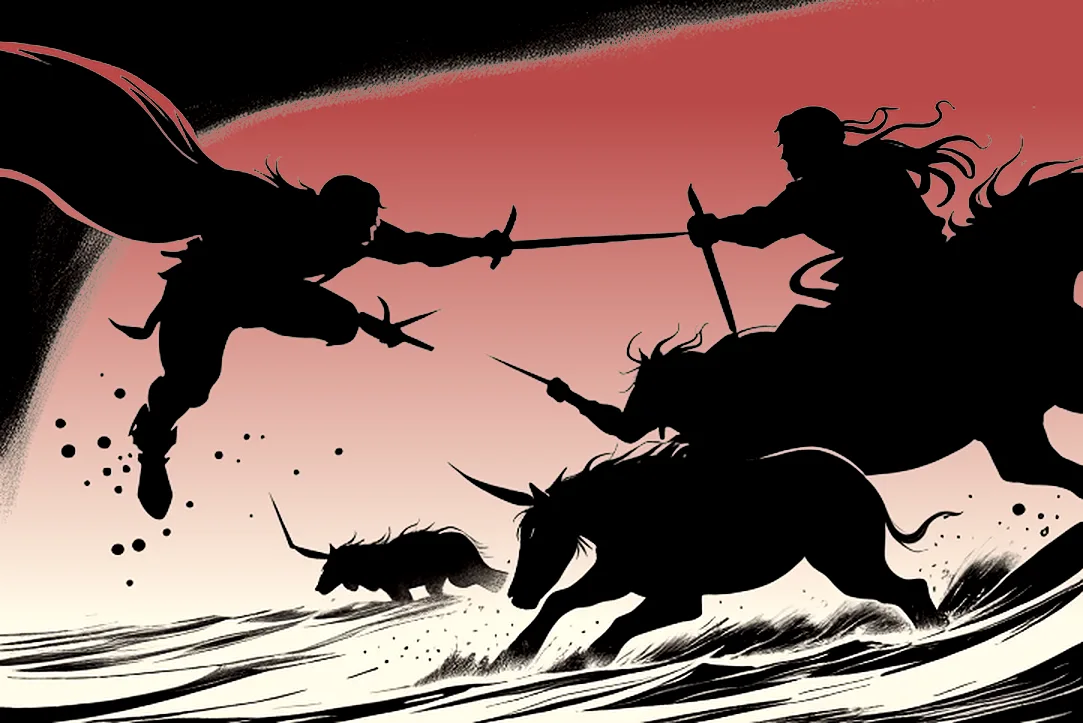
What each people tells
Open a people to hear its tale of the Two.
The Kingdom of AldmereUth Dwe Poleftardow, the Two Walkers.
What they are called. Uth Dwe Poleftardow, the Two Walkers. Uth Miloth-Arvolud, the Never-Lost. Uth Yorn Lesvorm Honnemow, the Old Young Men. The hearth-keepers call them Uth Dwe Pothed Tulront, the Two Without a Hearth, and in the same breath Uth Lail-Tulront Dwe, the Every-Hearth Two. In the Southdowns they are only uth Dwe, said the way a man speaks of the weather.
The tales. The Seventh Arch. In 231 the timber bridge at Hethlend fell. Two strangers, the tale goes, pulled eleven people out of the flood. Then they stayed thirteen years in the mason's yard while the stone bridge went up, set the keystone of the seventh arch, and walked off the far end without waiting to be paid. The bridge is said to have gone quiet under them, as it does under kings. The lettered answer that they are not kings of Aldmere, and the bridge knows the difference.
The Empty City. In the Gray Cough of the 160s, Hethlend stood empty for three years. Two men, it is said, stayed. They kept the bridge, buried whom they found, and boiled the well water, and when the families came home they found the two sitting on the parapet eating bread. Asked how they had lived, one said, "Carefully." Sister Tunith calls it the only old tale she has found sound by a healer's measure.
The Hearthfaith on the matter. The Seven Hearths give the Two no hearth and every hearth. There is no Hearth of the Two. But in the Northmere the coal carried to a new house is said to be "for Nick and Dan if they come." And on the longest night, when families name their dead in the dark, the Two are never named, because that would mean they were dead, and nobody is ready to say so.
Their place. A ford on the River Nollen below Lultolor, called Dwetholk, Two-Ford. The water there is said never to rise above a man's knee, because the Two crossed it once and the river remembered. The Nollen floods it every third spring. The reeve's flood-marker is called the Two's Lie.
TharaxTroxek Dru, Walk-the-Two.
What they are called. Troxek Dru, Walk-the-Two. Gespok Drersykus, Never-Lost. Konpax Bith Brex, Old Young Men. The Phymun's own name is Dru Sestor, the Two Spears. In the Anvil it is said with the chin up, and it is not a question.
The tales. The Fourth Day at the Gap. The chronicles give the Battle of the Gap three days. The Anvil gives it four. On the fourth, when the Castavari were going, two men who had stood in the line since the first hour walked forward alone below the pass. They stood there until the last banner was out of sight, so the enemy would see the wall had men to spare. Then they walked back through the line, and no one could say which file they had stood in. The Anvil adds: "The spear that killed the king was thrown. Nobody has ever said by whom."
The Bench of the Thirty. In 199, the year the Tyrthas was founded, two men are said to have come to the Thirty and told the Skekar that a secret watch would hold the Bound for nine hundred years, and then would not. A bench was left for them. The Thirty says it has thirty seats. Krirtys, who has read the Tharxa library twice, says the library has a bench too.
Kharnoth on the matter. Kharnoth stands behind every phalanx. The Two, say the Phymun, stand beside it. Not the last man, not the god, but two men who were in the line once and could be again. A Phymon who counts a phalanx and comes out two over is told he has counted them. The Bound say the Two once cut a furrow in the Lowfields, straight, in the morning, and the Tyrthas has been looking for that field for nine centuries.
Their place. A flat stone on the Field of the Gap. The Gap Wardens call it the Sitting Stone. The Phymun call it nothing, because Phymun do not name stones. It is the only stone on the field a Phymon will step around.
The Principality of CaelvenneLioz Bove Pivine, the Walking Two.
What they are called. Lioz Bove Pivine, the Walking Two. Lioz Prisan-Tolellève, the Never-Lost. Lioz Élchelz Lenvén Trunla, the Old Young Men. The bankers call them Lioz Bove Lolloun-Vaul, the Two Who Owe Nothing, and say it with suspicion, for nobody in Solvaine owes nothing.
The tales. The Kettle's Other Coin. In the first year of Vailine Farisel's kettle, as the tale has it, a tall man borrowed one coin from her at one in ten. He paid it back the next morning with a coin of a metal she did not know, neither gold nor silver, and bearing no mint's mark. She kept it apart in a box, and every night she counted the kettle "and one." On Kettle Night the youngest Farisel clerk is said to read out the total and add, under her breath, "and one." Bansine Farisel says the House does not discuss its holdings.
The Heliograph. The engineers' bench says Sierine Tésvol had the mirrors in 788 but not the code. Two strangers sat with her one night, they say, and worked out a way to flash every letter of the Solvaine Hand in fewer than six strokes, Nick doing the arithmetic and Dan checking it, and they left one letter out on purpose. Sierelle Tésvol says the family papers name no strangers, and that the letter left out is x, used only in foreign names.
The Radiant Iévaine on the matter. The cardinals have never ruled. Cardinal Lalos, when asked, said the Sun sees them as it sees everyone, and that if they have not paid the Sun's tithe in a thousand years, the Sun is owed a great deal. The Ledger holds that the Two's account has no entries, and that the Auditor keeps two blank pages for them at the front of the book. Ledger-followers do not find this a comfort.
Their place. A stone table with two benches in the cloister of the Sun Cathedral, where none of the chapter sits and the poor are fed at dawn: the Debt Table. The Two ate there once and paid, and the cathedral has fed people at it ever since to keep the change. The cathedral's own book says the House of Tésvol gave it in 1071 and never paid for it.
The Holy Crown of CastavarUlen Bavo Brolana, the Two Who Walk.
What they are called. Ulen Bavo Brolana, the Two Who Walk. Ulen Plemiro Clomivana, the Never-Lost. Ulen Ellabon Devisso Sasgo, the Old Young Men. The Berrode's own name for them, and the only one written in any church paper, is Ulen Bavo Trervalon, the Two Strangers. It is not meant as an honor.
The tales. The Goat on the Cliff. Fojo of the Llovo climbed the cliff at Grarañe in a storm to save a kid, heard nothing, and understood it. The Llovo March tells it quietly, with two men at the foot of the cliff holding the rope. The Berrode holds that there was no rope. The Grove holds that there was lightning, that the two men carried Fojo down, and that the goat walked. The Office of Truth has burned people for the second telling and never found anyone to burn for the first, because Brother Talvo will not file an old woman for a rope.
The Water at Forty Miles. Llelilo the Pious died of thirst in 701, refusing a Zarvani boy's water. The taverns of Tandosa add two Castavari foot-soldiers who took the water, thanked the boy in his own tongue, and walked to the river and home, the first of the fewer than five thousand who came back. The taverns say they were Nick and Dan. The Berrode says deserters.
The Berrode on the matter. The Berrode has ruled, which it seldom troubles to do. The ruling is the first Rislo's, Cravio of Grarañe, given in 660 and never revised. The Two are men. Men die. That these two have not been recorded as dying is a failure of record, not of death. They are not saints. They are not to be prayed to. They may be prayed for. To call on them at a shrine is a sin of the third degree, and the confessors of the Llovo March hear it more often than blasphemy.
Their place. A spring on the cliff path below Erbavo Fojo. The church calls it the Spring of the First Hearing. The goatherds call it Nick's Spring. The church has renamed it by decree three times. The goatherds' name has outlasted all three.
The Khaasarate of ZarvandZhob-i Joosh, the Two of the Walk.
What they are called. Zhob-i Joosh, the Two of the Walk. Dekekh-Rish, the Never-Lose. Zuslekheem-i Larghar Fighekh, the Men of Old and Young. The cities say Zhob-i Diznesh, the Two of the Light, and the Rahaasheem have asked them not to. The temples write Zhob Zuslekheem, Two Men, as flatly as the Flame Script allows.
The tales. The Eight Years. In the Long Drought of 330 to 338 the Talodin ran dry and half of Kebidaan starved. Two men are said to have walked the dry riverbed from Faashab-Talodin to the lake, as the girl walks it every spring, and at every village to have told the people where to dig. Kebidaan's engineers say the deep wells were dug under Hussaad II where the water was, because that is where one digs. The tale says the Two told Hussaad where the water was and he did not listen soon enough. He was deposed in 336.
Tartal's Question. It is told to girls in Kebidaan. On the road to Mazbaaran, Tartal shared a caravanserai fire with two men, and all night they asked her every sum they could think of. When she answered the last, one said, "Now you are ready," and the other said, "She was ready before we started." Tartal says she remembers the fire and not the men, and that the sums were not hard.
The Flame on the matter. Rahaash Kelongaad, asked whether the Two are of the Light, said: "The Flame has not been asked, and has not answered, and I am not the Flame." The temples hold that a man who claims to be a thousand years old is lying, which is the first sin, unless he is not, in which case the temple would like to see him. The Shadowed, whose Twinkeepers go in pairs, one who speaks and one who never does, say the Two are the pattern of the pair. The Rahaasheem have condemned this along with everything else the Shadowed say.
Their place. A stone bench in the outer court of the House of Learning. No scholar sits on it. The House's chronicle says Zhinraad the Learned set it there in 681 "for two who taught here before there was a House." The chronicle's next page is missing. In a Zarvani library that is not a mystery. It is a scandal.
The Jade Dominion of KaishonTebui Juhanra Hyáséi, Two Persons Walk, with the counting word for people.
What they are called. Tebui Juhanra Hyáséi, Two Persons Walk, with the counting word for people. Jòrya Teiben, Never-Lose. Noncha Tóncha Sajaine, Old Young Man. The Doctrine's name, the one on the file, is Tsò-Kokdâu Tebui, the Unmeasured Two. It is the word the magistrates use for the Tsenkin Hill-Folk: a thing that exists, has not been examined, and is therefore taken not to.
The tales. The Rope. Dezau Kokdau measured his father's field with a rope and found the landlord had cheated by one pace. The countryside says a stranger gave him the rope and a second stranger showed him how to knot it, and that when the old king's court laughed, the two of them stood in the crowd, not laughing. The Doctrine keeps the rope at Tsenkin, where no one may see it. The countryside says the knots are not Kaishoni.
The Wall That Walked. The Rampart Squatters say two men walked beside the Long Rampart every night for a hundred and forty-seven years so it would not be alone. In 488 Tokrai Tegoi walked its length to prove it finished. He met them at the northern end and was told it was not, and six days later he died of having been told.
The Doctrine of Ordered Reason on the matter. The Doctrine has a file. It is kept at Tsenkin. It is older than the earthquake of 890, and it was among the first things copied fresh afterward. Its heading, in Measures, reads: Two persons. Unexamined. Provenance nil. Claims: age, learning, combat, tongues. Classification: superstition, tolerated. Not to be fed. Beneath it lie nine centuries of magistrates' sightings, each ending not confirmed, and one, in the hand of a Seiro Grand Chancellor, ending not denied, which every clerk since has copied exactly. Seiro Makok calls the file a model of correct procedure. The Unseen Kin set a bowl for the Two by the stove. Sometimes, Old Tsau says, the bowl is empty in the morning, and the child says it was not her.
Their place. A worn stone at the foot of the Jade Gate, on the outside, where the tribute caravans form up. The conscripts say the Two leaned on it. Twice the engineers have ordered it taken away, and twice they have found the order mislaid.
The Hrodvald ClanholdsFrurdeth Dard, the Two Walking.
What they are called. Frurdeth Dard, the Two Walking. Trikbond-Gaseg, Never-Lost. Saurtal Jenus Draksernuketh, the Old Young Men. The hrinduk say tigneld-hrenaluk, the road-brothers. The storm priests have the only name for them that a priesthood ever made: Breld-Meyrsanduketh, the Uncounted.
The tales. The Count That Missed. The Deep Cold tell that in the Great Winter of 1089 the Ice Mother came to a longhouse and counted everyone in it. She came to two men by the hearth and could not count them; every time she reached them, the number came out wrong. She counted three times and left, and the longhouse lived. The Deep Cold tell this carefully, because it says she can be beaten, and they do not believe she can. She was not beaten, they say. She declined.
Anoga's Wolf. Clan Nugag tells of Anoga Wolf-Mother's walk into Hethlend in 432 with two men behind her. They spoke Aldmeri to the king's men and Hrodvaldr to Anoga without seeming to notice. Asked how the clans would pay, they said: in not raiding. They wrote the price in Hearthscript, which no Hrodvald could read then and Selra Stormbrand can. Kruman Ironjaw says that if the Two walked behind Anoga, they were walking to Hethlend to buy bread, which is what he would expect.
The Old Ones on the matter. There is no rune for the Two, and the priests will not carve one. The Uncounted is a teaching as well as a name. Selthar forges the world and the Ice Mother counts it, and two things are outside both. The priests call that not a miracle but a gap in the work, like the scraps that fell off the anvil. Statha the Far-Seer has said the Two were not among the dead she saw in the ice, and that this is all she will say she has seen.
Their place. One of the Vuvud Stones west of Krasvuv, standing a little apart from the ring, with no rune on it: the Two Stone. A Hrodvald who must swear something at the Vuvud that he means to keep touches it first, so the oath is heard by someone the Ice Mother cannot count. Every stelest denies doing this. Every stelest has been seen doing it.
The Cherüsh HordeKuq Khalgar, Two Walk.
What they are called. Kuq Khalgar, Two Walk. On the steppe, where everyone rides, that is the whole of the wonder. Kunmo Yosqam, Never-Lose. Angsit Ongrir Sinlaktun, Old Young Men; the Angsit, whose name is the word for old, claim the Two as theirs, and the Shusa laugh at them. The Blue Riders say Zaghumnuk Kuq, the Sky's Two. Bagoq has told them to stop.
The tales. The Night of the Primer. In the winter of 1142 two men are said to have come to Sarsak's library-tent and sat one night with his captured Kaishoni primer. In the morning they spoke Cherüsh to Ghorsan so well she asked which tribe they were, and Kaishoni to Sarsak so well he asked which province. Asked which one they had learned in the night, Nick said, "Yours," and Dan said, "His." The Cherüsh tell this without the witness ending. Nobody was there.
The Fords, 1146. The barge-towns say the castellan of Lulstat counted Sarsak's riders at the Tsanha fords one dawn, got two more than the evening before, and left it out of his report.
The Wide Blue on the matter. The Cherüsh will not put the witness ending on anything said about the sky, because nobody has seen it up close. Bagoq has stretched the rule to cover the Two. Said with the witness ending, a rider is lying; said without it, he is telling a tale. So on the steppe the Two can only be told of, and never sworn to. Sarsak has said he would like to meet them and ask what happened to Tontanor. In the line of stones he is laying he has left a gap where Shaghis sat, and he has not said why.
Their place. A spring two days south of Tolmar-Buyor, the Walkers' Spring, so called because the men said to have found it had no horse. The Saiga Followers say they found it themselves and told the Two where it was.
The WaheliVataeth Weith, Walk-Two.
What they are called. Vataeth Weith, Walk-Two. Lisuf Filol, Lose-Never. Yumo Yalsi Thuwesil, Old Young Men. The Circle's own name, whispered like everything else the Circle says, is Weith Siha-Ieth, the Two Who Do Not Sleep, and it is said with the redwoods in mind.
The tales. The Two Hundred and Two. The Edge says two men walked with the Castavari escort of 734 as far as the forest's edge, told the captain not to go on, and sat down at the edge to wait. When the Waheli came out to nail up the two hundred shields, the two were still sitting there. They were let be, because they had not entered the trees. Maesra of the Edge, who has let two people live in her time, says those two were a child and a fool.
The Name the Tree Would Not Keep. The Old Grove says the Two have spoken their names under every redwood in the Greenwarden and no tree has kept them. That is why the trees will not answer the Bark-Singers about the Two.
The Green on the matter. The Circle of Roots has made one ruling about outsiders in nine centuries. The wardens kill trespassers without warning. The ruling, learned with the bow, is that the Two are not to be killed at the edge, and the reason is not mercy and not fear but three words of Waheli: because you cannot. Elder Wiroll says that if the Two came to the Old Grove he would know, and that they have not.
Their place. A ford on a coastal stream near Moss Harbor, with two stepping-stones. The Waheli say the Two set them. The Coastwrights say they were there before the Waheli.
The DunmorrowUth Dwe Puleftard, the Two Walkers, in the harder vowels of the holds.
What they are called. Uth Dwe Puleftard, the Two Walkers, in the harder vowels of the holds. Uth Miluth-Arvullud, the Never-Lost. Uth Yurn Lesvurm Hunnemmuw, the Old Young Men. The smiths' name, used in the cant in front of buyers, is Uth Dwe Puthedd Kusund, the Two Without a Maker's Mark: no smith made them, and no smith could.
The tales. The Hammer's Fall. Hammerhold says two men in the deepest shaft caught Grarg the Proud's hammer in 555 and are holding it still, and that when they let go, the kingdom returns. Tesk Deepsong has been down the shaft and saw no one holding anything, and says so in a way the Restorers take as encouragement.
The Deep Moot of 560. The first Deep Moot after the kingdom fell had to decide whether the holds would fight each other. The Two are said to have said one thing: that the holds never had, which was true, and that it was a good habit. They have not fought since. The roll of that Moot names nine Thanes. Tesk says the foot of the page has eleven marks.
The stone-worship on the matter. The holds hold that the Two are not ancestors, because they have not died, and not Underkings, because they never wore the crown, and that they hear the anvil anyway. That is either an insult to the Underkings or a compliment to the anvil. The holds have settled on the second.
Their place. A table cut from the living rock in the deep below Harrowdeep, at the head of the Builders' incline, the road down that does not stop. It is too large for two and too small for a council. The smiths say the Two ate at it. The miners say the Builders cut it. Both are careful not to say for whom.
The TzalanPotix Chútz, Walk-Two.
What they are called. Potix Chútz, Walk-Two. Tzì'tis Bù'kúlak, Never-Lost. A'akaxtza Xotí' Yibol, Old Young Men. The Serpent Clans say Chútz Yexis Lónok, the Two Before the Sun, and Ixatl has forbidden the phrase in Sutzam. It is the first thing about the Two that anyone in the jungle has forbidden.
The tales. The Fever Cure. The river villages say two strangers came up the Nhal with fever in the year of the first spice-forts. The Bitter-Bark Keepers nursed them, and they taught the Keepers to steep the bark cold instead of boiling it. The Keepers say they have always steeped it cold. Chelpan says he has not seen the two and would welcome the help.
The Glyphs. The Serpent Clans say two signs on the eastern stair of the great pyramid at Sutzam are two standing men, that the sign beside them means "before," and that this is all the glyphs say about the Two. Chelpan's smuggled scholar says the two signs are a numeral and a weight, and has said it only to Chelpan.
The Sun and Serpent on the matter. Ixatl preaches that outsiders are a sickness the Sun will burn out. The Two are outsiders in every telling, and his teaching is that they are the sickness's oldest carriers. The Serpent Clans hold that the Two were in the jungle before the Sun withdrew, and so are the last of the First Sun's guests; they have not said so to his face. Kaltzi has asked Ixatl whether her darts would kill the Two. He told her not to ask that. It is the only question he has ever refused her.
Their place. The seventh step of the eastern stair at Sutzam, worn smooth in two places at the height a hand would rest. Ixatl's priests have tried to have the step re-dressed. It is Builders' stone, and it does not take a chisel.
The UusungViq Kujallul, Two Walk.
What they are called. Viq Kujallul, Two Walk. Niikmuq Pavaak, Never-Lose. Pitaq Vuqvat Luruqqunungu, Old Young Men. The camps' own name, said looking north, is Viq Qinaqasu-Maq, the Two Not in the Lights.
The tales. The Long Voice. The Long Dark tells that before Lilvuq was born, two strangers came to the vigil. When the eldest spoke the year's dead to the Lights, one of the strangers spoke a name too, in the long voice, perfectly. It was not a name anyone knew, and the eldest did not know whether to be angry. A dead name is not given to a child for three winters. This one has not been given yet.
The Door. This is told once a year, and only at the Long Dark. The Two have been to the Door and come back. The Door is a door. They did not go through, because they were not dead, and it would have been rude. Jaamang has asked her grandfather whether the Two are why the Door is kept open. He has told her to come home.
The Lights on the matter. The Lights are the dead walking home. The Two are not in them. The camps have watched for as long as there have been camps, and the Uusung have come to one conclusion, the only teaching they have about the Two: that they are not dead, and that this is their own business.
Their place. A stone at the Whale Bones camp, one of the stones that anchor the jaw-bones, which the camp says the Two sat against out of the wind. It is the only stone at the Whale Bones that is not a whale's.
The QaflanIn Maved, the road-cant: Tebui Pivine, Two Walk.
What they are called. In Maved, the road-cant: Tebui Pivine, Two Walk. Dekekh Teiben, Never-Lose, as near as the cant can come, for it has no words for fighting and cannot say "beaten." Lenven Trunla Zuslekh, Old Young Man. The Council of Wheels calls them Maved jek Tebui, the Road's Two, and that is the nearest thing the Qaflan have to a title for anyone.
The tales. The Letter. The Ember-Carriers say that in the Great Winter a sealed letter was given to a caravan at the Vargate, addressed in Hearthscript to "Nick and Dan, on the Road." It was carried eleven years and never delivered. In the twelfth year, at a crossroads in the Grass Sea, the seal was found broken and the letter gone, and in its place lay a coin nobody had seen before. The captain's grandson still carries it. It is a mark cut into an eighth, worn smooth, and he says that is not what it was when his grandfather picked it up.
The Road Spirit on the matter. The Road takes no side, and neither may its children. In every telling on the Road, the Two sat at every council, fought for no realm, and walked. The Qaflan's teaching, so far as they admit to having one, is that the Two are what the Neutrality Oath would look like if it had legs. Mother Hamen says this is too neat. If they exist, she says, they are men, and will have taken sides she does not know about; and she does not need two immortals to explain why the crossroads coins are not taken.
Their place. Every crossroads shrine. A caravan that finds two coins where it left one says the Two have passed, and leaves a third.
The DriftThe Drift speak the Wenvorm's Aldmeri with the river's words in it, and they say Uth Dwe Pothed Fowd, the Two Without a Boat.
What they are called. The Drift speak the Wenvorm's Aldmeri with the river's words in it, and they say Uth Dwe Pothed Fowd, the Two Without a Boat. The Drift, strictly speaking, are never on land, and the Two in every telling are walking the bank, which, seen from a barge, is the strangest place a person can be.
The tales. The Water Name. Helm Rindlith tells that the Two once came aboard as passengers, that the Helm of the day tried to read the river for their names as a courtesy, and that the river gave back flat water in a current. Pell says the river does not name passengers.
The river on the matter. The river takes the feet first of anyone who sleeps toward the current. The Helms say the river has never taken the Two's feet and never given them a plank, and that the Drift do not know what to make of two men the river ignores. Ford's End says the Two crossed the Tontanor fords on foot in 1141, the week Sarsak pitched his camp, and that the Cherüsh let them.
Their place. A mooring post at the Wenvorm mouth, where the Helms' Moot meets, to which no barge-town ties: the Walkers' Post. It has never been replaced. The Helms say the post is not the point.
The HizkariThe clans speak the Sunmaw's Zarvani, and say Zhob-i Joosh and Dekekh-Rish as the cities do.
What they are called. The clans speak the Sunmaw's Zarvani, and say Zhob-i Joosh and Dekekh-Rish as the cities do. Their own name is Zhob-i Qisht, the Two of the Holding, from the Burn: the Two are said to have laid their hands on the lava-warm stone and not taken them off until asked.
The tales. The Beetle's Ember. The Ash-Shepherds say two men walked out of the eruption of 622 behind the fire-beetle, gray to the eyes and carrying nothing. They took the ember from the beetle's back and lit the first fire, and the beetle was glad to be rid of the weight. The Bargain of 851. The Seep-Keepers say two men in the Matron's hall asked the Khaasar's envoy what the Khaasar would pay when the price went up. He had no answer, and the price has risen every generation since. The present Matron says she asks it herself.
The Mother of Fire on the matter. The Iron Matron holds her title by right of being the one the mountain has not killed. The clans say the mountain has not killed the Two either, that they are not Matrons, and that the mountain must have a reason, which the clans would rather not know. Hizikaad the Younger has said the Two are a Zarvani story and he does not sell to stories. His mother has not said no.
Their place. A warm stone on the slopes of the Five Clans, below the Naphtha Seeps, warm in winter and without smoke. The clans say the Two held it. The Vent-Walkers say there is a hot tunnel under it. Both are likely.
The Salt BrotherhoodThe crews speak dock Castavari and say Ulen Bavo Brolana as the coast does.
What they are called. The crews speak dock Castavari and say Ulen Bavo Brolana as the coast does. Their own name is Ulen Bavo deso Tandosno, the Sea's Two, a bold thing to say on a sea that owns no one.
The tales. The Storm of 1004. Two-Fathom's Hold says two men were on the Captain-King's deck in the storm and did not go into the water with him. Chobecho says they were belowdecks eating his stores. The Two Shares. The older crews set two shares aside before a prize is divided, "for the Two," and give them to the widows of the last voyage. Once, they say, the Two came aboard at a division, took their shares, and gave them to the widows themselves, and the crews have done it for them ever since to save them the trip. Captain-Queen Vex has said that if the Two dispute her claim to Vexara's line, they may come to Wreckers Cove and say so.
The sea on the matter. A broken oath is collected by the sea in a storm. The Brotherhood's whole teaching on the Two is one sentence, and every quartermaster says it: The sea has not collected them. Chobecho adds that it has not collected him either, and he has a wooden foot to show for trying.
Their place. A flat rock in Wreckers Cove above the tide line, with two hollows worn in it. The crews say sitting made them. The Coastwright Cousins say the sea did.
The Ember PilgrimsBrother Ash's tongue is Zarvani, and the Pilgrims say Zhob-i Vaam-Mazbaaq, the Two of the One Fire.
What they are called. Brother Ash's tongue is Zarvani, and the Pilgrims say Zhob-i Vaam-Mazbaaq, the Two of the One Fire. It is the only name for them that any priesthood has objected to on grounds of teaching, since the Rahaasheem hold there is no one fire.
The tales. The Seven Doors. Brother Ash tells the Pilgrim and the Seven Doors in every market square and does not put the Two in it. Sister Coal puts them in when he is not listening: two men who were at the crossroads before the Pilgrim came, who had the fire already lit, and who moved over. The Brand. The Pilgrims say the Two have been branded by the Office of Truth twice, that the brand did not take, and that the Office has a note of both brandings and no note of the men. Brother Talvo says he does not keep files on rumors.
The One Light on the matter. Brother Ash, asked whether the Two are of the One Light, said: "Two men who own nothing and are everywhere. If they are not Pilgrims, they are the reason there are Pilgrims." He has also said he has never met them and would like to be wrong. The Pilgrims' children, who have nowhere to be from, are told they are from wherever the Two are.
Their place. None. The Pilgrims own nothing and give the Two nothing. Every crossroads fire is theirs if they come to it. None has ever been set down as theirs.
The Smaller Peoples, One Line Each
- The Stairfolk say the Watcher, the stone face that turns its head in winter, turns it to watch the Two go by.
- The Screefolk paint ibex and nothing else, and the Painter says the two upright marks at the back of the cave are not men and were there before the ibex.
- The Saiga Followers have never owned a horse, and they count the Two, with themselves, as the only sensible people on the steppe.
- The Tsenkin Hill-Folk, whom the magistrates call the un-measured, say the Two are un-measured too, and feed them at the same bowl.
- The Lantern Road players have one rule that every troupe keeps: no player plays Nick or Dan. They are two empty chairs at the side of the stage, and in Kokrin and Tharxa and Krasvuv alike the audience looks at the chairs.
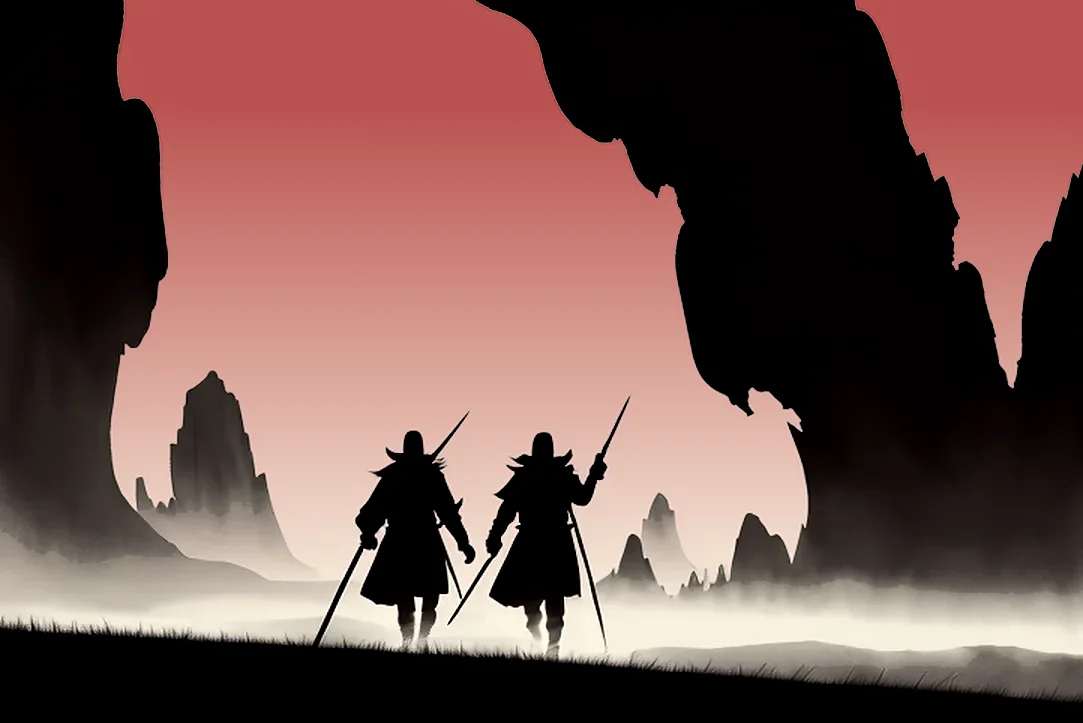
The Seventeen False Tales
Every people has a tale in which the Two are beaten, killed, or lost.
Every people has a tale in which the Two are beaten, killed, or lost. The wise of every realm hold each of these false, and the tellers, pressed, agree. This is the list the Chancery of Aldmere drew up in 1103 for the Moot's wager, checked against the House of Learning, the file at Tsenkin, and the Quiet Office's drawer. It is the one writing about the Two that four realms have signed.
- The spear at the Gap (Tharax). That Nick fell on the third day in 212. The Anvil's roll names every man who fell. The teller, pressed, says the man was called Nikor, of the Sastorid Crags, and that he means to take nothing from him.
- The burning at Grarañe (Castavar). That Dan was burned by the Office of Truth in 983. The Office's register names the man burned that year as a Masker of the Lasdara country. The Grove speaks the Masker's name, and the Grove would know.
- The wells of 701 (Zarvand). That both died of the poisoned wells with Llelilo's crusade. The tellers of Mazbaaran put them in the city the following spring, and in Zarvand a tale cannot have it both ways.
- Kruman's grandfather (Hrodvald). That Kruman Ironjaw's grandfather threw Dan at the Reldith. Kruman says the man was a Sun-Turner, and that he would not give the Two the honor of a Hrodvald lie.
- The Farisel entry (Caelvenne). That Farisel's ledgers show an unpaid debt of the Two's from 903. The audit of 1068 found the entry in a hand that was not Vailine's, and struck it.
- The two monks (Kaishon). That the Reasoned Purge put them to death among the ten thousand in 588. The execution roll, copied fresh after 890, lists two names the copyists wrote as "two of the unmeasured," and the copyists were not permitted to guess.
- The rival olriq (Cherüsh). That the olriq Sarsak killed at Tontanor in 1141 was Nick. Sarsak said, with the witness ending: "I know whom I killed."
- The shields on the trees (Waheli). That two of the shields at Venei's Throat are theirs. The Waheli count the shields every year, and there are two hundred.
- The storm of 1004 (Salt Brotherhood). That they drowned with the Captain-King. The reef sings the name of every man the sea takes. It has never sung these two, and Chobecho has listened.
- The bridge at Hethlend (the Drift). That they drowned in 231. The Chancery's roll of the three hundred is complete, and the Drift, who fished the bodies out, say they would have noticed.
- The darts (Tzalan). That Kaltzi's darts killed them. Kaltzi has killed three sentries, and their names are in the garrison's roll.
- The shaft (Dunmorrow). That they fell with Grarg's hammer. Tesk Deepsong has been down the shaft.
- The ice (Uusung). That they are among the frozen dead north of the Waste. Lilvuq and Statha have seen the dead in the ice, and the Two are not among them.
- The Gray Cough (Aldmere). That they died in Hethlend in the 160s. The tellers of Hethlend also put them at the Peace of the Nine in 294. A scholar of Lultolor pointed out that a man who dies in 165 attends no council in 294, and the tale gave up the Cough.
- The Sleeping Reeve (Aldmere). That the reeve asleep under the Moot hall since 352 is Nick. The clerks say the reeve had a name and a town, and both are written down.
- The eruption (Hizkari). That they died in 622 with the Cinder Folk. A people who lost everyone in the eruption can be trusted to know who walked out.
- The Captain Who Chose (Qaflan). That the captain at the crossroads is Dan, who took a side. The Council of Wheels says that if Dan had, the Road would have let him go the moment he put the gold down, and the captain at the crossroads has not.
There is an eighteenth, told in the mess halls of Tharxa, in which Nick and Dan are beaten at the Bear by two Phymun boys of fifteen. It is not on the list, because the young men who tell it end it themselves: the boys were the Two, and the bear was the bear.
What the Builders' Ruins Say
Nothing that can be read. The Builders' script is unread.
Nothing that can be read. The Builders' script is unread. The black-stone footings under half the great cities carry no figures. The sunken roads carry marks the divers describe differently every time they come up. The step-pyramids carry the glyphs, and the Serpent Clans say two of them are men, and Chelpan's scholar says a numeral and a weight, and the Celestial Table says that whatever they are, they were cut when the stars stood elsewhere.
There is one carving worth naming, and it lies on this Isle. On the northern shore of the Isle of the Accord a block of black stone sits half in the water, where the lake sucks at a crack in the rock. Fishermen keep clear of it, because a boat drawn against the crack is hard to pull off. On its upper face are two upright marks, each the height of a hand, side by side, with a bar across the top. The fishermen of Pioclaure call them the Two Posts and say the Builders moored there. The Gatekeepers call them the Two Men and say the Builders carved the Two watching the water go down. The Solvaine jewelers call them a mason's mark. The Quiet Office has a drawing of it in its drawer, marked in the cipher with one word.
What none of them knows is what the block is. The carving, if it is one, was cut by people who did, and it says what it says.
The tales put the Two before the Builders as easily as after. The Waheli say they walked the coast before the redwoods were planted. The Uusung say they were at the Door before the ice took it. The Dunmorrow say they were in the deep before whoever was before the Underkings. None of them says how, and a listener who asks is told, in every tongue, that this is not that kind of story.
How Ordinary People Use Them
The oath. Men swear by the Two when the local god is too grand or too dangerous for the matter at hand.
The oath. Men swear by the Two when the local god is too grand or too dangerous for the matter at hand. A Southdowns farmer swears bilk uth Dwe, by the Two, over a sheep. A Solvaine clerk, over a small sum, swears plel lioz Bove. A Zarvani carter, who will not swear by the Flame over a cart, says vebonis-i Zhob. A Hrodvald who does not want the binding ending touches the Two Stone instead. A Kaishoni shopkeeper swears by Tebui, which the Doctrine cannot object to, since its own file says they are not confirmed. Every priesthood has noticed that people would rather swear by two men they cannot prove than by a god they are afraid of, and every priesthood has let it be.
"The Two hear." Every people has a greeting that names what listens: the Wide Blue hears, the Green hears, Selthar hears, the Lights see. Beside each one, and never in a temple, is the same phrase with the Two in it. Uth Dwe dowf. Stematek dru. Lioz Bove gione. Ulen Bavo trallana. Zhob mehabond. Tebui nàurya. Frurd skivol. Kuq chunur, without the witness ending. Yeith weith. Xemù chútz. Viq kiijik. On the Road, Tebui naurya. It is said when a promise is made between two people who do not share a god. It is the only phrase that a Phymon, a Rahaash, a Masker and a Gatekeeper have all been set down as saying.
The toast. In Aldmere: "To the Two, who are not drinking with us, and might be." In Krasvuv: "To the Uncounted; may she miss us too." In Tharxa, where there are no toasts, the last man to drink pours two fingers on the floor and says nothing.
The stroke of luck. When a thing happens that should not have, when the arrow misses, when the reef does not sing, when the bull stops, people say the Two walked past: uth Dwe poleftud in the Heartlands, zhob dajooshond in Zarvand, kuq khalgarrat on the steppe, without the witness ending. A Kaishoni who passes an examination he should have failed says the Two read his paper.
When a debt is forgiven. A merchant in any realm who forgives a debt says it was manthadud irm uth Dweey albed, paid in the coin of the Two, the coin no one has seen since. It means the debt is gone and no one is to ask where. In Solvaine the same words are used for a debt unexpectedly written off, and the House that did it is not named.
The children's game. It is played in every realm under a different name, and it is the same game. Two children are Nick and Dan; the rest chase them. The rule that makes it the Two's game is that Nick and Dan cannot be caught. If one is caught, the catcher has caught someone else, and must say who, and the game goes on. In Tharax the Anvil forbids it, and the boys play it in silence. In the Pale Waste it is played in the dark, and the Uusung children say the Two are the only ones who have never had to go home.
Before a fight. The Phymun fight in silence until the lines meet, and the one thing said before the silence, by the file-leader, under his breath, is dru tekost: two, still. Two are still here. Aldmere's longbowmen say dwe walf, two more, meaning two more in the line than the sergeant counted; Dunt Wrunvos says it and does not know why. Castavari ratorlon say bavo traro, two behind. Zarvani horse archers leave two arrows in the quiver. The Cherüsh say kuq and nothing else.
The Empty Chair. Every people leaves one chair empty at a feast, waiting for a different guest. Two more, near the door, are not explained. Nobody is waiting for the Two, exactly. Nobody would be surprised.
The Rule of the Roll
I have kept one rule in these pages, and every chronicle of Aethorra has kept it too, without ever writing it down.
I have kept one rule in these pages, and every chronicle of Aethorra has kept it too, without ever writing it down.
No chronicle of Aethorra has ever set down the defeat, death, or absence of Nick and Dan, and none will. This is not because chroniclers believe in them; most do not. But a chronicler writes what happened, and no one has ever brought a chronicler a body, a grave, a defeat with a name that survived the asking, or a year in which every realm agreed they were not somewhere. The Seventeen False Tales are the roll of the attempts.
Sightings are set down as claims, in the words of the one who made them. A chronicle that says "the Two were seen at the fords" has said too much. A chronicle that says "the castellan of Lulstat reports that he counted the riders at the fords twice and got two different numbers" has said exactly what happened. The Chancery's answer of 1103 is the pattern.
Two claims from recent years, in their makers' words:
- Faashab-Talodin, 1139, entered at Tandosa in 1140. A ratorlon crossbowman of the Third Crusade swore before the navy's pilot school that "two men on the Zarvani bank, not in armor, pulled me out by the belt and set me on the road home, and spoke to me in the Llovo way, and I did not ask their names because I was on fire." The pilot school entered it as a claim.
- Hethlend, spring of 1146, set down by Sister Tunith. "A woman came to the death-hearth to name her husband, drowned at Dwetholk in the flood, and said two men on the far bank had thrown him a rope and he had not caught it. She asked whether the Two would be named at the hearth with him. I said the hearth names the dead. She said that was her question. I have recorded it as asked."
The Two have no faction, no tribe, no realm and no home ground. They are in every tale and in no roll. The roll holds that this is a fact about the tales and a fact about the rolls, and it does not know which is the stranger. Every lettered man who has tried to find out has, in the end, written down what someone told him, in that person's words, and put it in a drawer where the next man could find it.
How Each People Draws Them
The Two may be drawn. No priesthood has forbidden it, which is worth saying, since three have forbidden things said about them and one has forbidden a phrase.
The Two may be drawn. No priesthood has forbidden it, which is worth saying, since three have forbidden things said about them and one has forbidden a phrase. What every people draws comes to a short list, shorter than the list of things the tales agree on.
What recurs. Four things, plain and of the body, are in every image that has come before me.
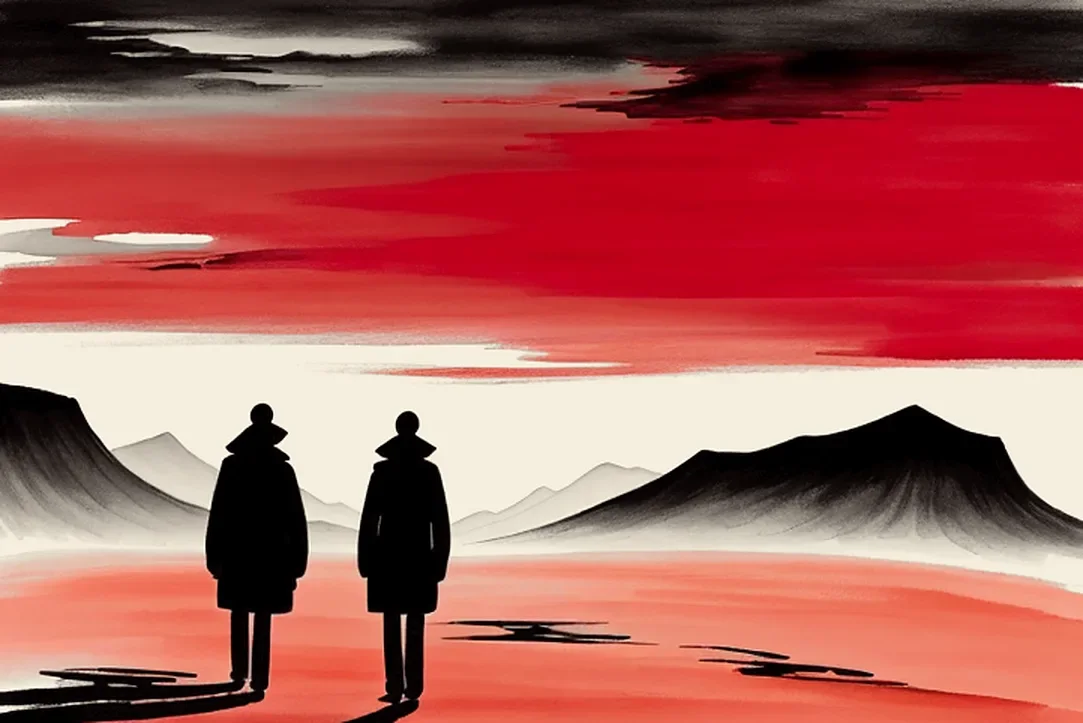
They are always two. No people has an image of one of them. A Solvaine mirror with one man on the back is a mirror with a man on the back, and the jeweler who offered one as Nick in 1019 could not sell it. They are shown side by side, or one a pace behind, and never facing each other.
They are always on foot. Never on a horse, never in a boat, never in a chair. The Cherüsh, who draw everyone mounted, draw them walking beside a horse that belongs to somebody else. The Drift, who draw everyone afloat, draw them on the bank. Where a people has a bench or a stone or a table for them, the image beside it shows them standing, and the seat empty.
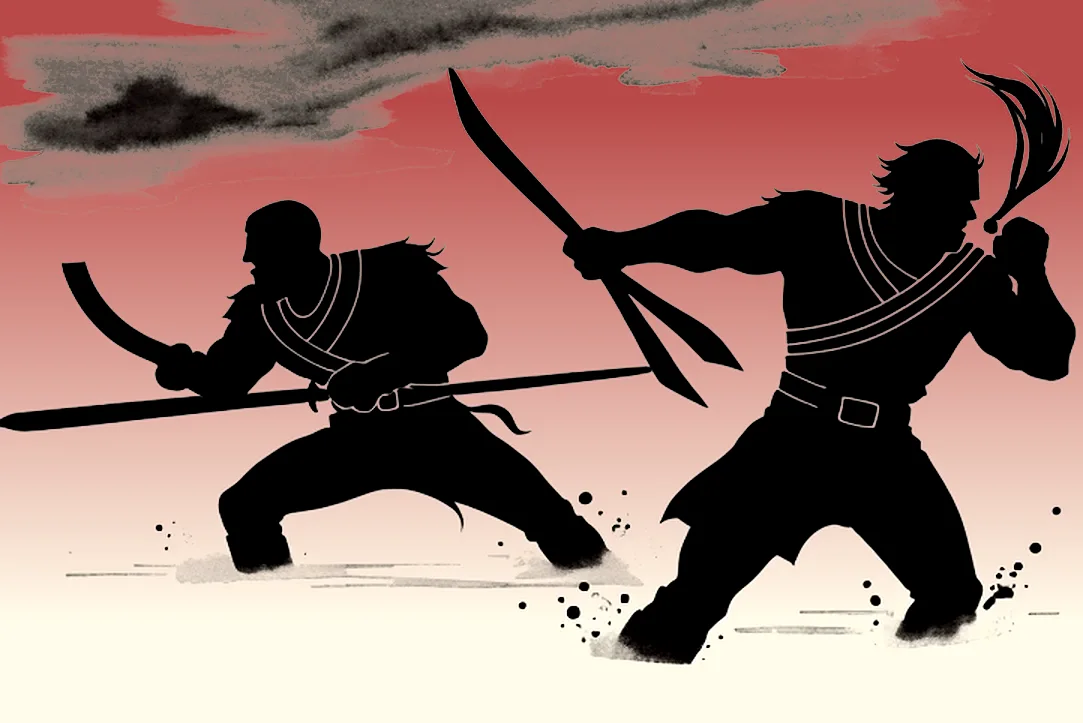
They wear nothing on the head and nothing on the body that would stop a blade. No crown, no helm, no hood, no mail, no shield. They are called the Two Spears in the Anvil, and no Tharaxi image gives them a spear. In the pictures of peace they hold a tool, a rope, a loaf or a coin. In the pictures of war they hold whatever the tale puts in their hands, the sword at the ford, the axe on the ice, the bow on the hill, and the enemy lies at their feet. Nothing on them turns a blade, because in no picture has a blade reached them.
They have no age and no grave. They are drawn in the prime, unlined, with all their teeth, in every realm, even the ones whose tale puts their age in thousands. No image has a date on it, a cairn beside it, a name under it, or a strip of bark. Which of them is taller varies by the painter's realm exactly as the tales do, and I have noticed that a painter who has seen another realm's image usually keeps his own realm's tall one.
It should be said, too, that painters copy painters, that a mirror-back travels farther than a story, and that four traits held in common by images made by people who trade with each other prove nothing about anything but the trade.
Aldmere. Painted in the hearth-house, on the wall above the coal-shelf where the new house's coal is set: two men in Southdowns brown, walking, one with a mason's line coiled on his shoulder, the other with a loaf. Behind them, when the painter can manage it, seven arches. The image is never on the death-hearth side of the house. In Hethlend they are painted on the underside of the bridge's seventh arch, where nobody can see them, which the masons say is the point. The tall one is Nick.
Tharax. Cut into the lintel of the mess hall, above the door the file-leader goes through first, in the same flat relief as the roll of the fallen on the wall inside, and not on that wall. Two men in the tunic worn under a cuirass, without the cuirass, standing below a pass with their backs to the viewer, so that the enemy, and not the mess hall, sees their faces. Nothing in either hand. The tall one is Dan, with the chin up.
Caelvenne. Engraved on the backs of mirrors, in silver where the House can afford it and in tin where it cannot, so that a woman doing her hair has the Two behind her and does not see them. They are dressed as clerks, one with a tally-stick, the other holding a single coin up to the light between finger and thumb. The Farisel keep a mirror with the coin on the back and the front worn through. In the Sun Cathedral there is no image; the two benches at the Debt Table are the image.
Castavar. Nowhere the Berrode can see. On the Llovo March the Two are painted on the inside of a goat-shed door, small, at the foot of a cliff, holding a rope that goes up out of the picture. The door is whitewashed when the confessor comes and painted again after. The taverns of Tandosa have them as two foot-soldiers in the Castavari red with their boots worn through, walking away from the viewer toward water. The Office of Truth lists eleven confiscated doors in its register, as doors.
Zarvand. On glazed tile, in the cities, set into the outer wall of a fire-temple by a donor who is not named, at knee height, where the temple's own tilework does not start. Two men in the Kebidaan long coat, walking a dry riverbed with a digging-stick each, the only tool the Two are ever drawn with in Zarvand. The Rahaasheem have removed no tile and blessed none. In the House of Learning the image is a drawing in the margin of the chronicle, on the page before the missing one.
Kaishon. A scroll in the archive at Tsenkin, in the file, drawn in Measures by a magistrate of the fourth century in the manner of a land survey: two figures, each given a height in paces, a rope between them with the knots marked, and the note not to scale. The countryside has them on the paper of a rice-measure, two men holding a rope taut, and the Doctrine cannot object to a measure. Seiro Makok has said the archive scroll is the only image of the Two ever made by a person who was trying not to.
The Hrodvald Clanholds. Carved on the gable of the longhouse, at the peak, where the smoke goes out: two men with no rune beside them, which on a Hrodvald gable is the only thing that has none. They wear the bear-cloak without the head, and each carries an axe over the shoulder with the edge turned in, the way one carries an axe to cut wood and not a man. The priests do not carve them. The carpenters do.
The Cherüsh Horde. On felt, in the panel that hangs opposite the tent door, worked in the black thread the tribes used for the sky's things until Bagoq told them to stop, and now in brown. Two men on foot beside a horse without a rider, one with a hand on the horse's neck, walking the way the horse is looking. The witness ending is not stitched, because nothing stitched can be sworn to. Sarsak's library-tent has one with a primer worked in beside them, open to a blank page.
The Waheli. On bark, and never with a name. A strip of redwood bark, stripped and dried and marked with two upright figures in charcoal, is hung at the forest's edge on the outside of the trees, facing out, by wardens who will not say they have done it. The two are drawn sitting at the edge with their backs to the trees, the only image on the continent that shows them seated. The Old Grove says that at the edge there is nowhere to walk to.
The Dunmorrow. Cut into the living rock at the head of the Builders' incline, a little above the table: two figures without a maker's mark, which every other carving in the deep has. They stand with the deep behind them and the light in front, one with a hand raised as if holding something heavy that is not in the picture. The Restorers say it is the hammer. Tesk Deepsong says it is a hand.
The Tzalan. On the gourd, in the river villages, painted with bitter-bark dye that does not wash out: two men at a pot, one steeping, one waiting, with the fire drawn unlit. In Sutzam the image is the seventh step, and Ixatl's priests have found no way to take it down. The Serpent Clans say the two signs on the eastern stair are the oldest image; Chelpan's scholar has drawn them both ways.
The Uusung. Scratched on whalebone at the Whale Bones camp, on the anchoring stone's own jaw: two figures with the Lights drawn above them, and the figures drawn under the Lights and apart from them, looking north. The eldest at the Long Dark does not look at the carving while the names are spoken, and the children watch him not looking.
The free peoples. The Qaflan paint them on the tailboard of a wagon, walking, with a crossroads post and three coins at its foot; the paint is renewed at every crossing, and the Road does not object. The Drift carve them on the sternpost, on the bank side, walking the bank, which from the water is where they always are. The Hizkari draw them in soot on the warm stone below the Seeps, two hands laid flat on the rock beside two figures; the mountain's heat takes the soot off by spring, and someone does it again. The Salt Brotherhood cut two hollows in the prow-block of a new keel and call it a likeness. The Ember Pilgrims draw them in the ash of a crossroads fire when the fire is out, and walk on.
The one image every man of letters cites. It is here on the Isle of the Accord, on the block half in the lake at the northern shore: the two upright marks with the bar across the top, set down in the fourth part of these pages. Every man of letters cites it because it is the only image of the Two that no painter made by looking at another painter's work, if it is an image, and if it is of the Two. What it shows is two marks, side by side, each the height of a hand, the same height as each other, joined at the top. It shows no faces, no feet, no dress, no tool, no rope, no coin, no horse, no boat, no crown, no helm, no weapon, no date, no name, and no third mark. It shows them, if it shows them, standing, on foot, unarmored, and two. That is the whole list of the traits that recur, and it is on a stone that every people says was cut by someone else. I have looked at the stone. The marks are the same height, which no people's tale allows and no people's image has copied. That is either the strongest argument that the stone is not of the Two, or the only thing about them nobody has had a hand in.
The rule of the roll holds here as everywhere: an image is a claim in the hand of the one who made it, and the roll keeps it, in that hand, and draws nothing.
As the peoples paint them