AETHORRA
dronon

The Kingdom of Aldmere

the steady middle
Tothsal tulront. — Hello. (Literally "good hearth.")
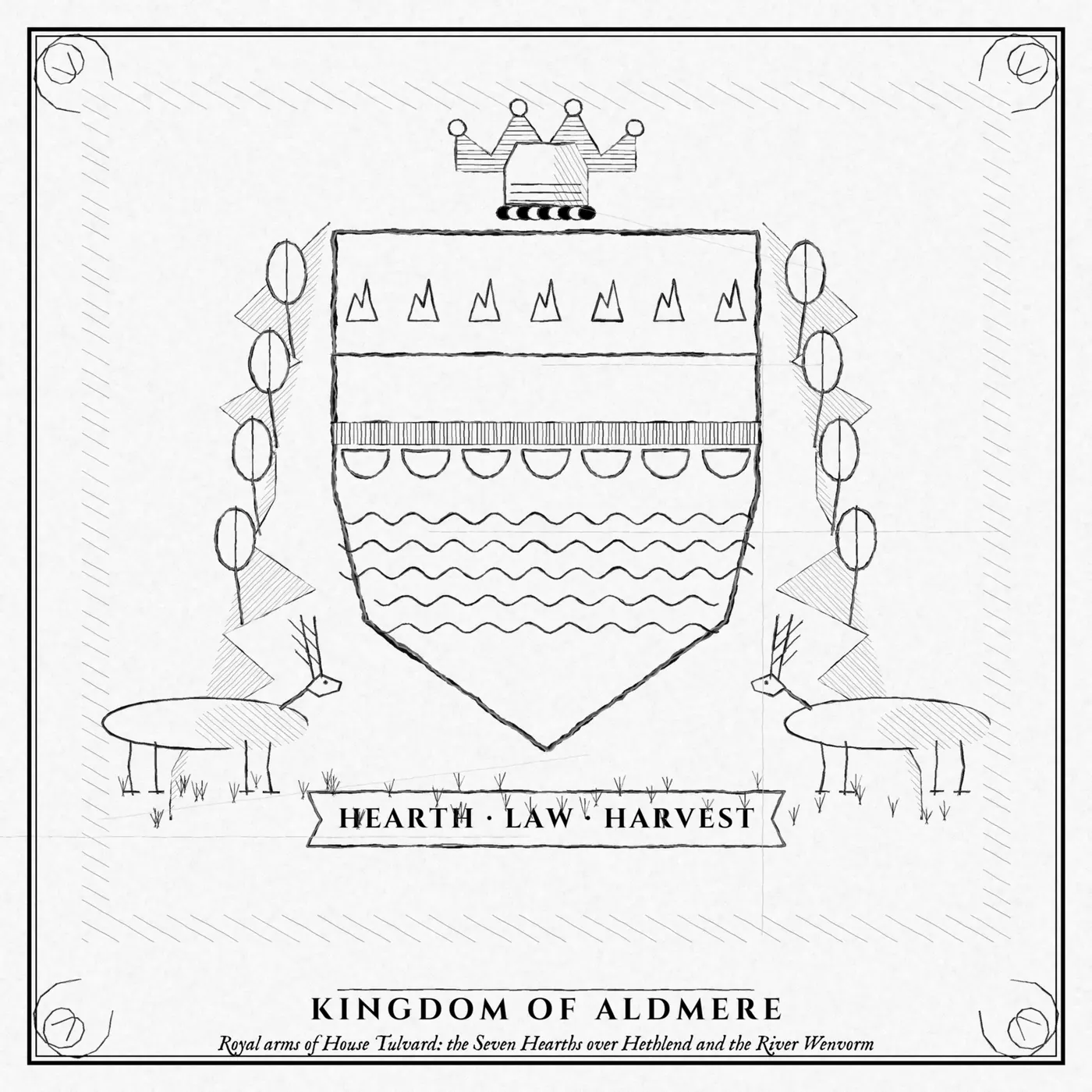
The crest of Aldmere
The words on the standard: Hearth, Law, Harvest

The Realm at a Glance

Territory
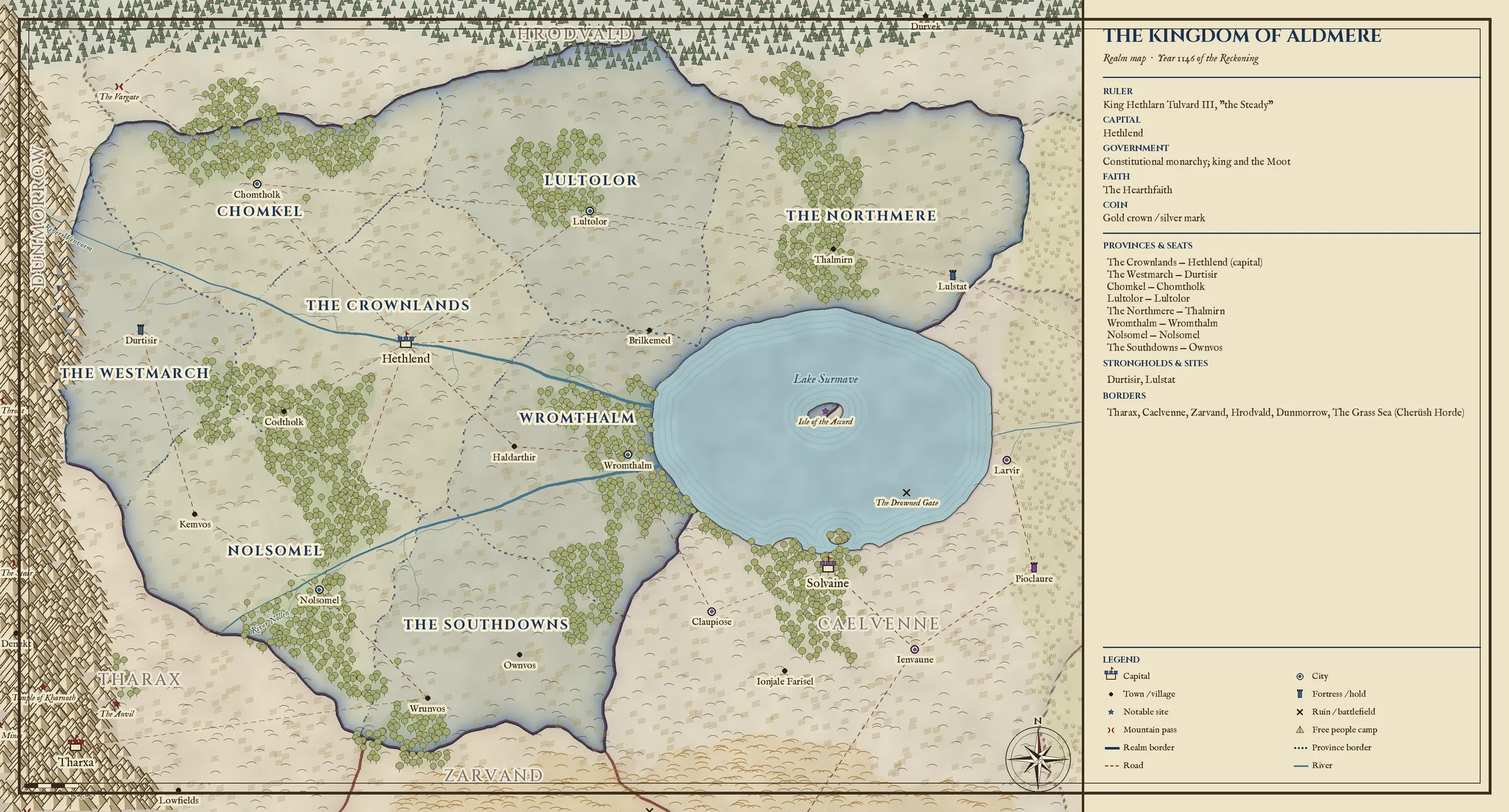
The Heartlands, from the eastern foothills of the Spine to the western shore of Lake Surmave, on both banks of the River Wenvorm.
Capital
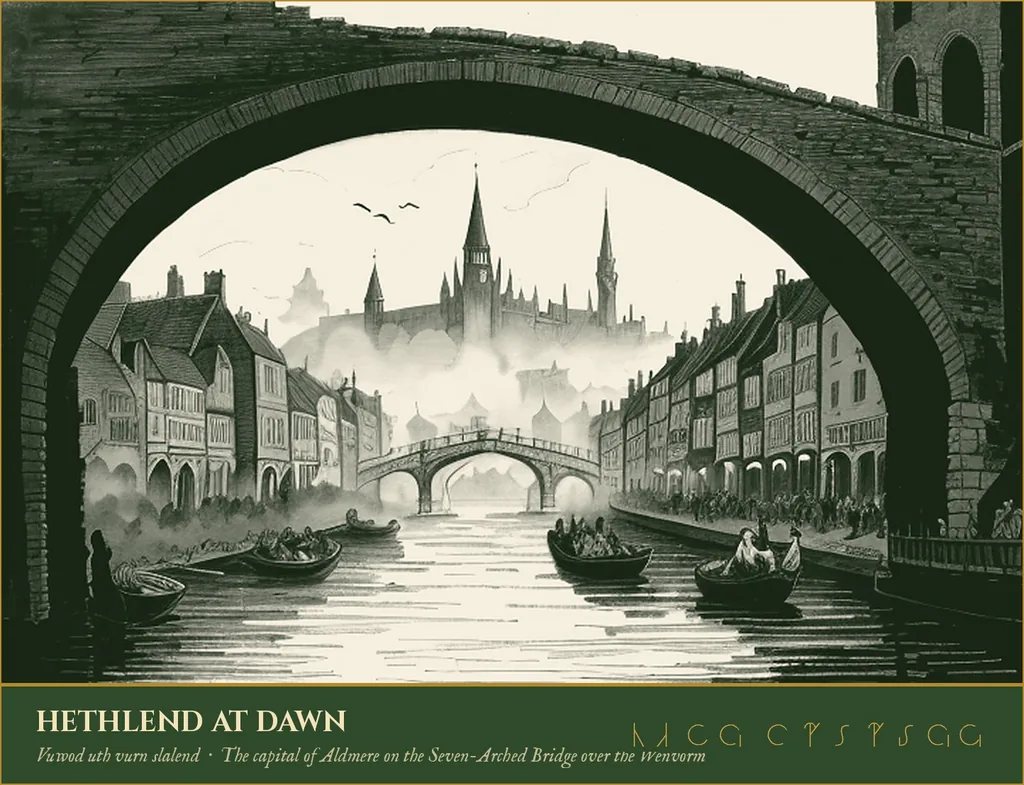
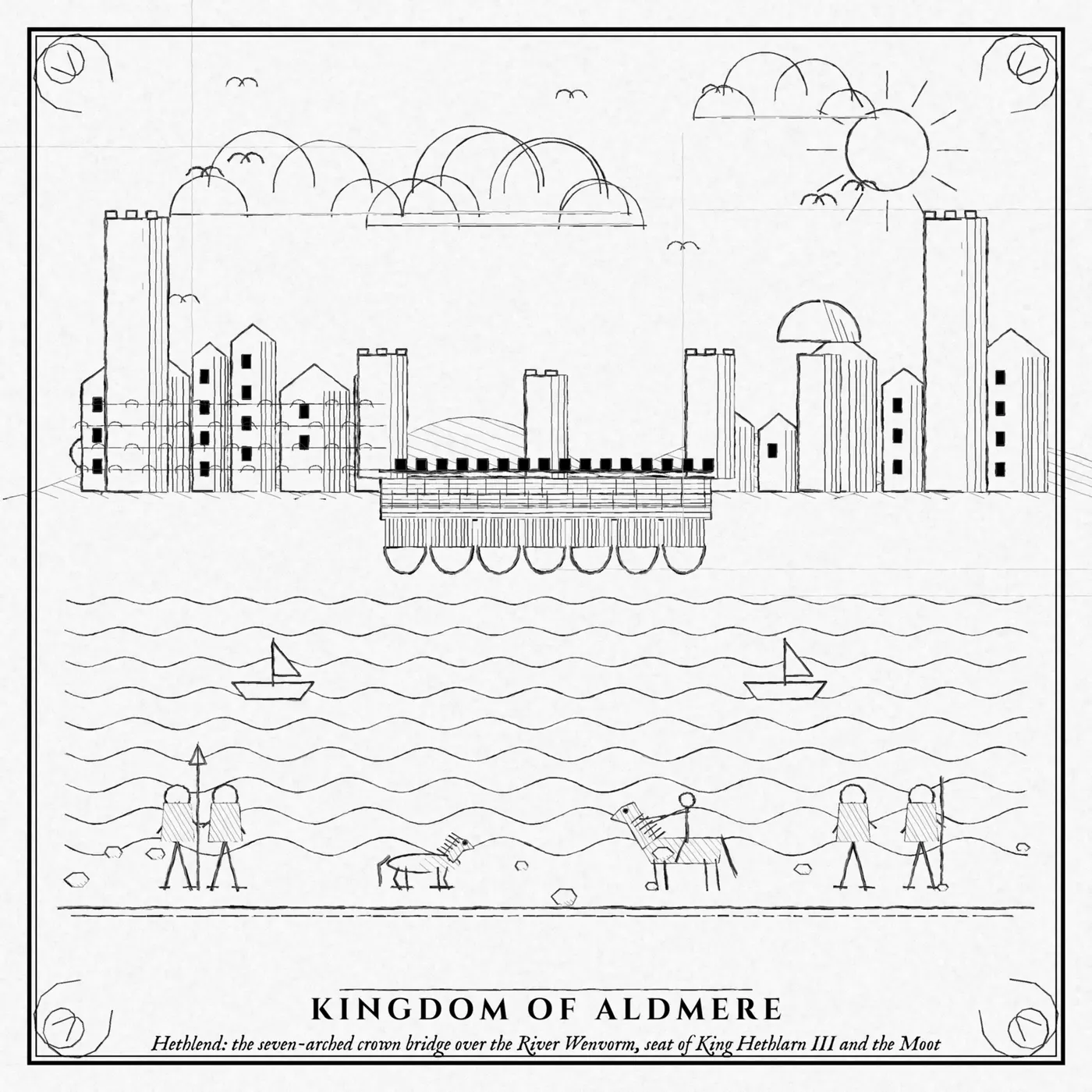
Hethlend, a walled city astride the Wenvorm on a great stone bridge of seven arches.
Other cities
Chomtholk, Lultolor, Wromthalm, Nolsomel.
Government
A king bound by law. The king rules with the Moot, a council of great lords and burgher-reeves chosen by the towns. Laws must pass the Moot; the king can refuse a law but cannot make one alone. Nobles hold land in fief (dukes, earls, barons, knights).
Ruler
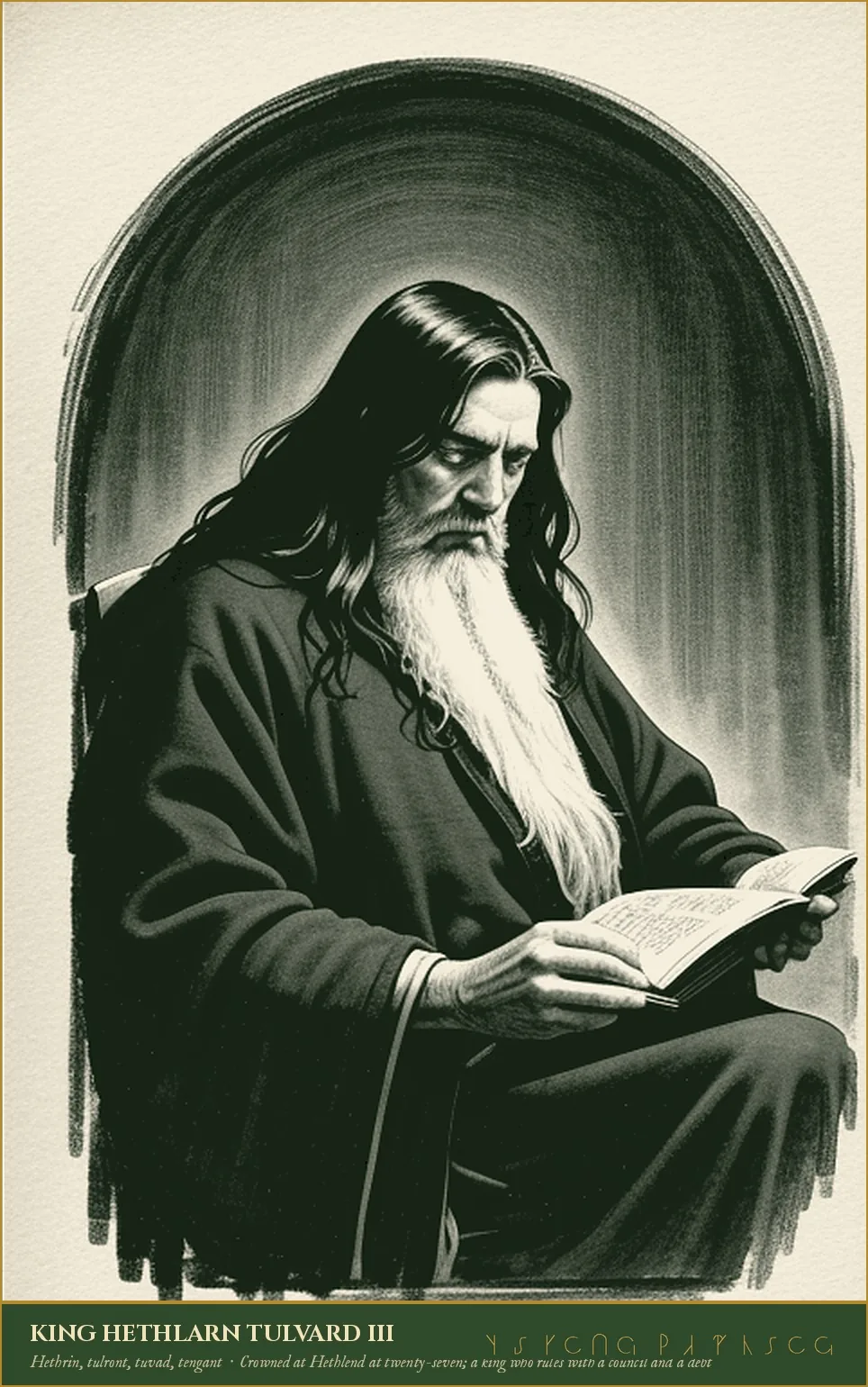
King Hethlarn Tulvard III, "the Steady" (52). Able, plain, and careful to a fault. His heir, Prince Hethbael (24), is restless and thinks his father too soft on Caelvenne.
Key figures
Lord Chancellor Tuvith Ownirel (who in truth runs the kingdom's business); Duke Minthor Durift of the western marches (who guards the Spine passes and resents the crown).
Religion
The Hearthfaith — a gentle company of Seven Hearths (Home, Harvest, Forge, Road, Healing, Law, and the Quiet Hearth of death). Worship is local and practical. Aldmere's law lets every man worship as he likes, and so dissenters from every other realm take refuge there.
Economy
Grain, wool, cattle, ale, timber, iron goods, river trade. Aldmere feeds half the continent, Caelvenne above all.
Military
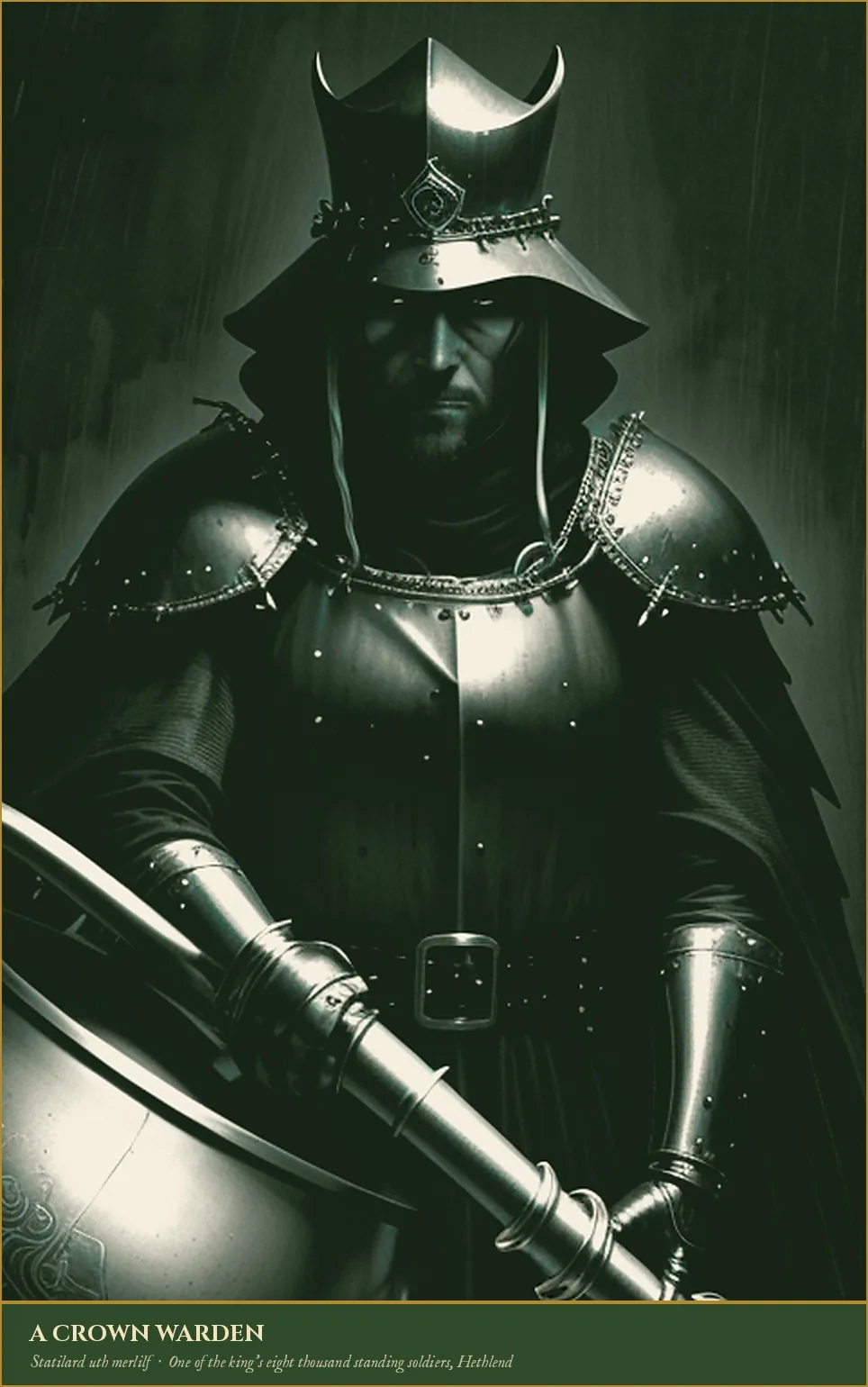
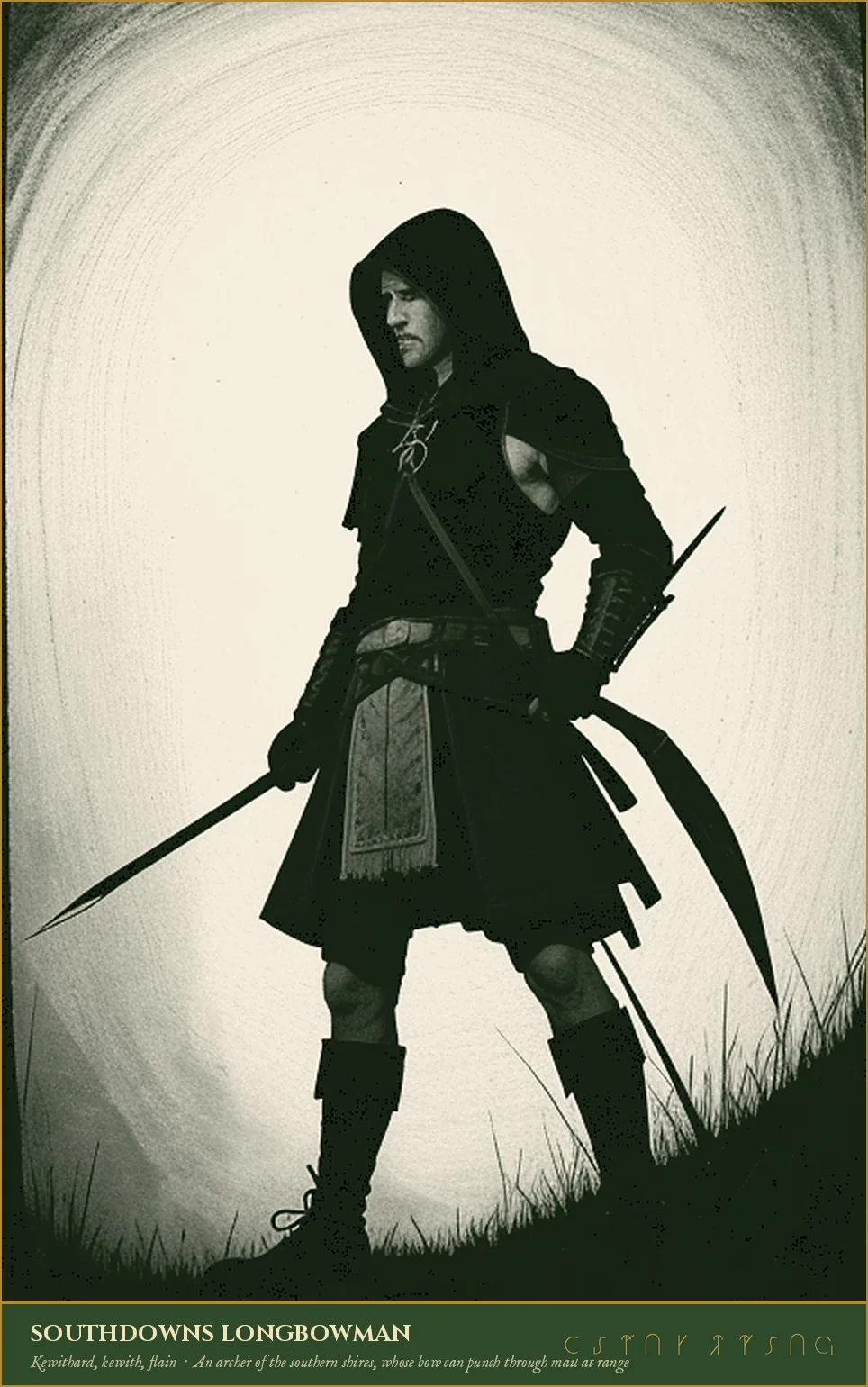
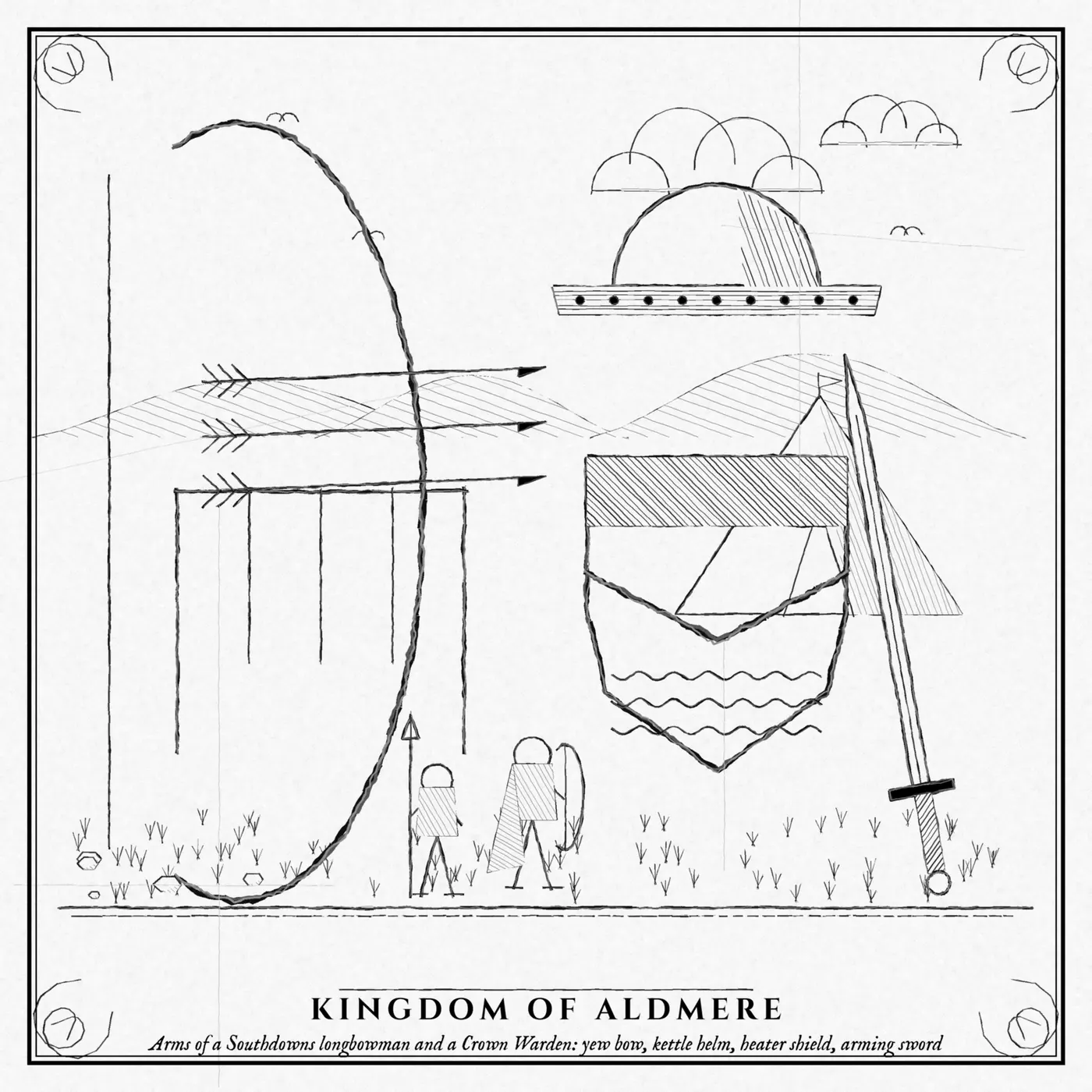
County levies raised by lords, and the standing royal Crown Wardens (8,000 men who fight for their living). Famous for the longbowmen of the southern shires. Sound at everything, best at nothing.
Architecture
Stone keeps and castles for the nobility; walled market towns; villages of timber frame, wattle-and-daub and thatch. Stone roads kept up by the crown.
Currency
Gold crown, silver mark. There is no copper coin: small change is a mark cut into halves, quarters and eighths, and a market scale is kept for weighing the pieces.
Strengths
Food enough for all, many people, good roads, the rule of law, a large and skilled middle sort of folk, and true peace within its borders.
Weaknesses
It borders almost everyone, and so it is everyone's second front. It decides slowly (the Moot argues). Its treasury is deep in debt to Caelvenne's banks. Great lords like Duke Durift act half as if they were kings themselves.

Plates

The sketchbook: crest, arms, landmark and heraldry sheets
The crest of Aldmere
Arms and gear
Arms and gear
Landmark
Landmark
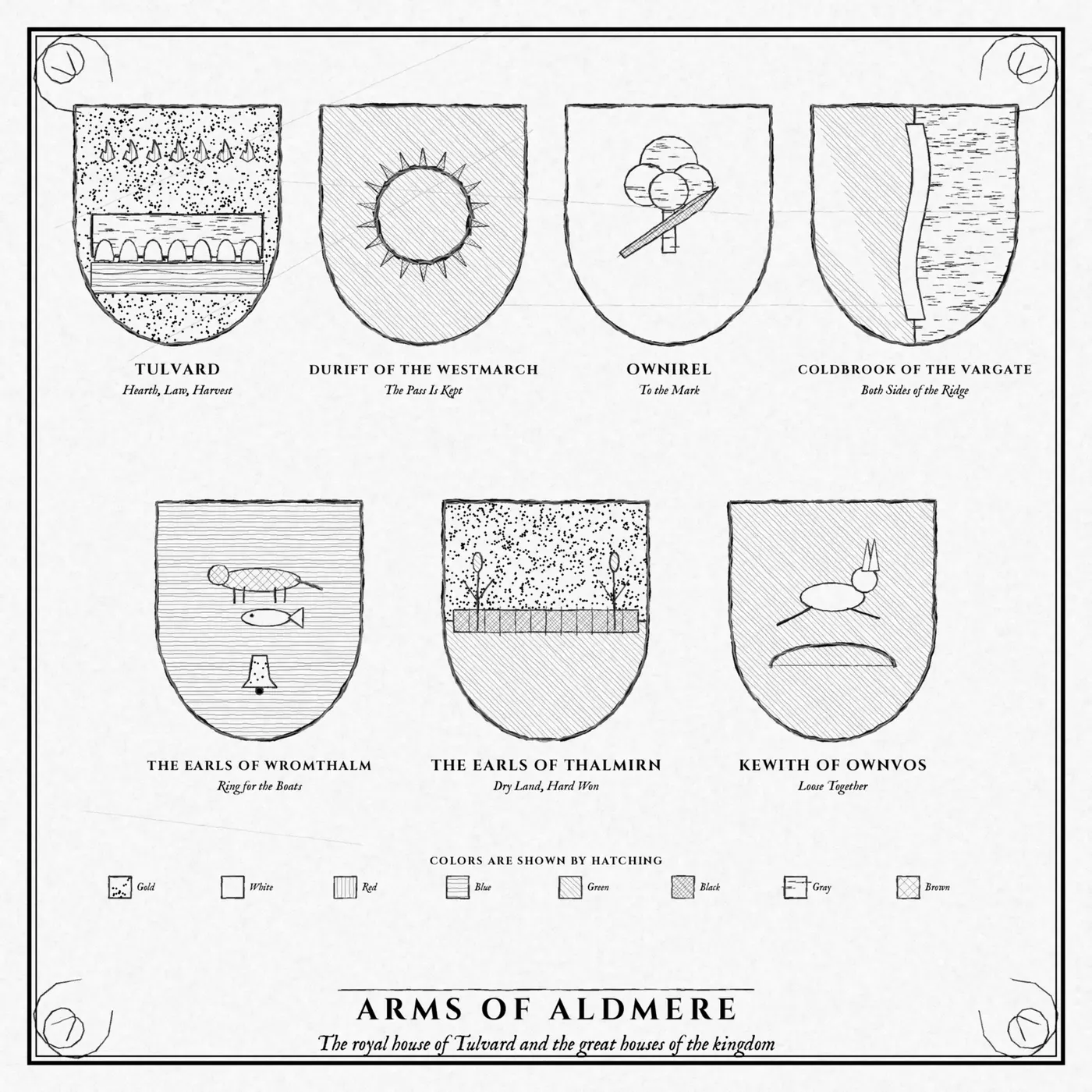
Arms of the great houses

The Land

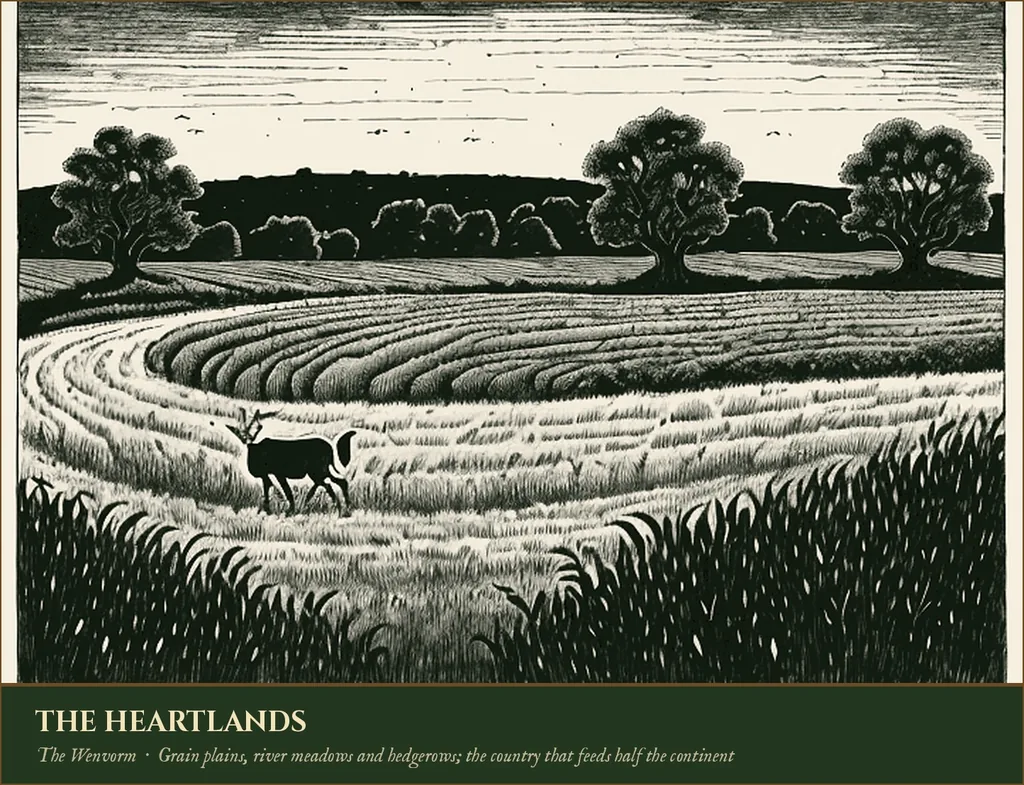
The Heartlands
The HeartlandsGrain plains, river meadows and hedgerows; the country that feeds half the continent
Realm map of The Kingdom of Aldmere. Tap to open it full size.

Provinces

The Crownlands

The Crownlands are the royal heart of Aldmere, the country around Hethlend on both banks of the Wenvorm. Every crown road in the kingdom starts here, running out from the capital to Chomtholk, Lultolor, Wromthalm, Nolsomel, the Westmarch and the east.

The Westmarch

The Westmarch is Aldmere's western frontier against the Karzhan Spine, held by Duke Minthor Durift, warden of the western passes. Its lords rebelled against the crown in the Lords' War of 822–829 under Duke Yornbael Durift over the Moot's right to tax them; the king won only with Tharaxi mercenaries paid in Caelvennois gold, and the Westmarch has distrusted Hethlend ever since.

Chomkel

Chomkel is the northwestern wool country around Chomtholk, rising toward the Vargate and the foothills of the Spine. Its dense-fleeced Chomkel sheep make the kingdom's second export after grain, its brewing barley makes Aldmere's ale, and its rooks follow the plow in black flocks.

Lultolor (province)

Lultolor is the northern shire between the capital and the Northmere, named for its city. It lies across the crown roads that link Hethlend, Chomtholk and Thalmirn, and on the realm map the town of Brilkemed falls inside it.

The Northmere

The Northmere is Aldmere's northeastern march along the north shore of Lake Surmave, reaching east toward the Tsanha fords and the Grass Sea. It suffered the last great Hrodvald raid in 1127, on Thalmirn, after which the crown finally fortified Lulstat and the Northmere.

Wromthalm (province)

Wromthalm is the lakeshore province southwest of Lake Surmave, around the city of Wromthalm and the mouth of the Nollen, and its road runs on into Caelvenne. It is a country of flax fields for linen, river otters whose pelts line noble cloaks, and fishermen who live on Surmave perch and smoked mere eel.

Nolsomel (province)

Nolsomel is the southwestern province of the River Nollen and its woods, stretching from the city of Nolsomel toward the Spine and the Stair. Its beech woods are home to the Nollen deer, royal game whose poaching is a hanging offense, and to the Nollen adder, the only venomous snake of the Heartlands.

The Southdowns

The Southdowns are the rolling downs and sheep pastures of Aldmere's south, famous above all for their longbowmen, who can punch through mail at range. Every Southdowns child is given a bow on the first day of spring and shoots at a straw hare, and those who hit it earn the village guild's hare tattoo at sixteen; Sergeant Dunt Wrunvos wears one.

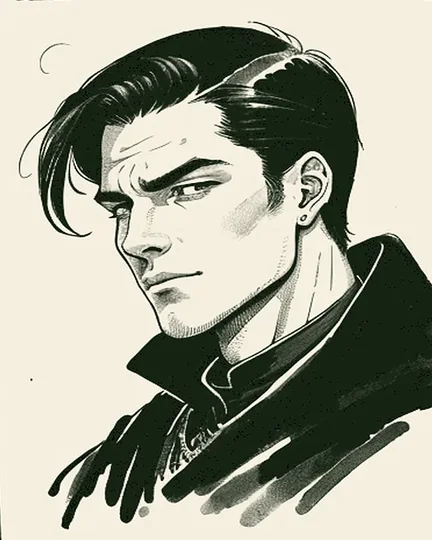
Voices of Aldmeredronon

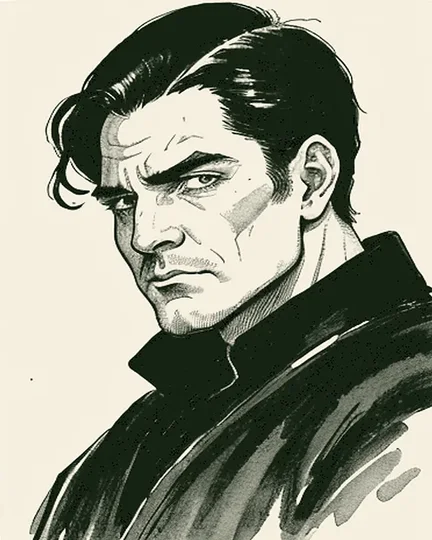
Portrait of King Hethlarn Tulvard III, "the Steady"

King Hethlarn Tulvard III, "the Steady"

King of Aldmere · 52

Broad, graying, a farmer's hands on a king. A pale burn scar across the back of his left hand from a kitchen fire as a boy, which he shows to children to explain why he's careful. Wears a plain circlet and old boots.

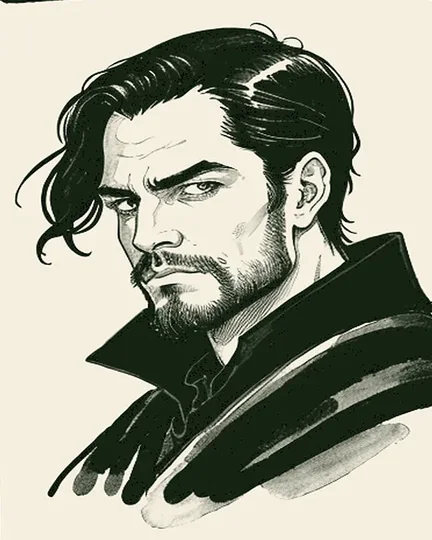
Portrait of Prince Hethbael Tulvard

Prince Hethbael Tulvard

Crown Prince · 24

Lean, fair, restless, handsome enough to know it. A small notch missing from his left ear from a hunting arrow that was a foot from killing him at sixteen; he tells the story differently every time. Rides better than anyone at court and fights better than his tutors admit.

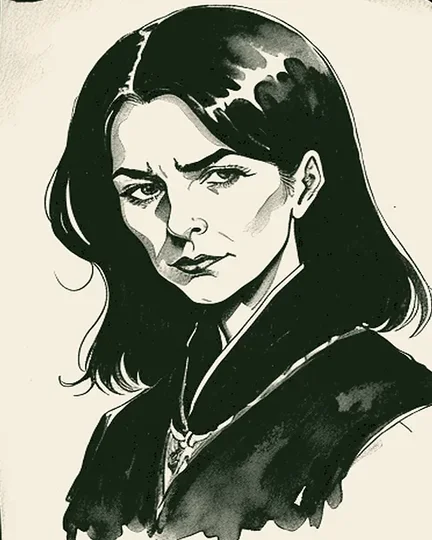
Portrait of Lord Chancellor Tuvith Ownirel

Lord Chancellor Tuvith Ownirel

Lord Chancellor, keeper of the treasury · 61

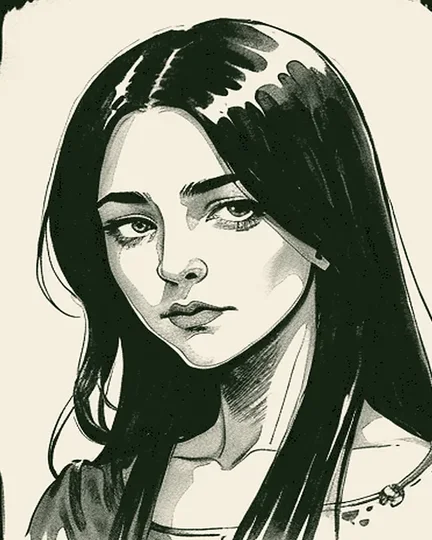
A small, sharp, gray-haired woman who has run the kingdom's paperwork for twenty-two years. Ink permanently stains the first two fingers of her right hand. Reading spectacles on a chain.

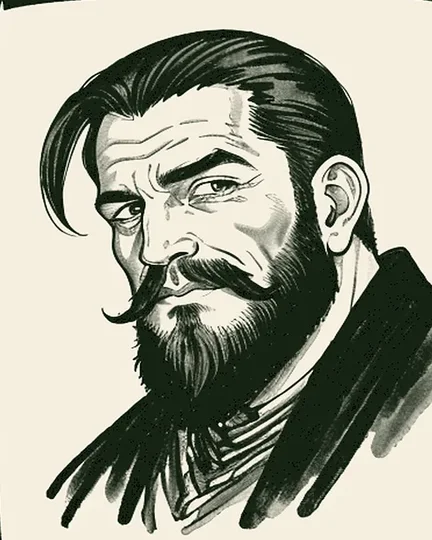
Portrait of Duke Minthor Durift of the Westmarch

Duke Minthor Durift of the Westmarch

Duke, warden of the western passes · 47

A bear of a man with a black beard going gray at the chin and a face weathered by mountain wind. A long white scar from the corner of his mouth to his ear, courtesy of a Hrodvald axe at Thalmirn in 1127; it pulls his smile into something worse than a scowl. His family has distrusted Hethlend since the Lords' War three centuries ago, and he has inherited the grudge whole.

Portrait of Dunt Wrunvos

Dunt Wrunvos

Sergeant of the Southdowns longbowmen · 33

A wiry commoner with forearms like rope and a right shoulder permanently higher than his left from twenty years of the bow. Missing the tip of his left index finger. Tattoo of a hare on his inner wrist, the mark of his village archery guild.

Portrait of Sister Tunith of the Quiet Hearth

Sister Tunith of the Quiet Hearth

Priestess of the death-hearth at Hethlend · 38

Plain-faced, round, calm, with a low soft voice that the dying find easier to hear than a loud one. Wears undyed gray and no jewelry. She sits with the dying of every rank and faith, and because of that she knows more secrets than the Quiet Office.

Cities and Townsvuwod

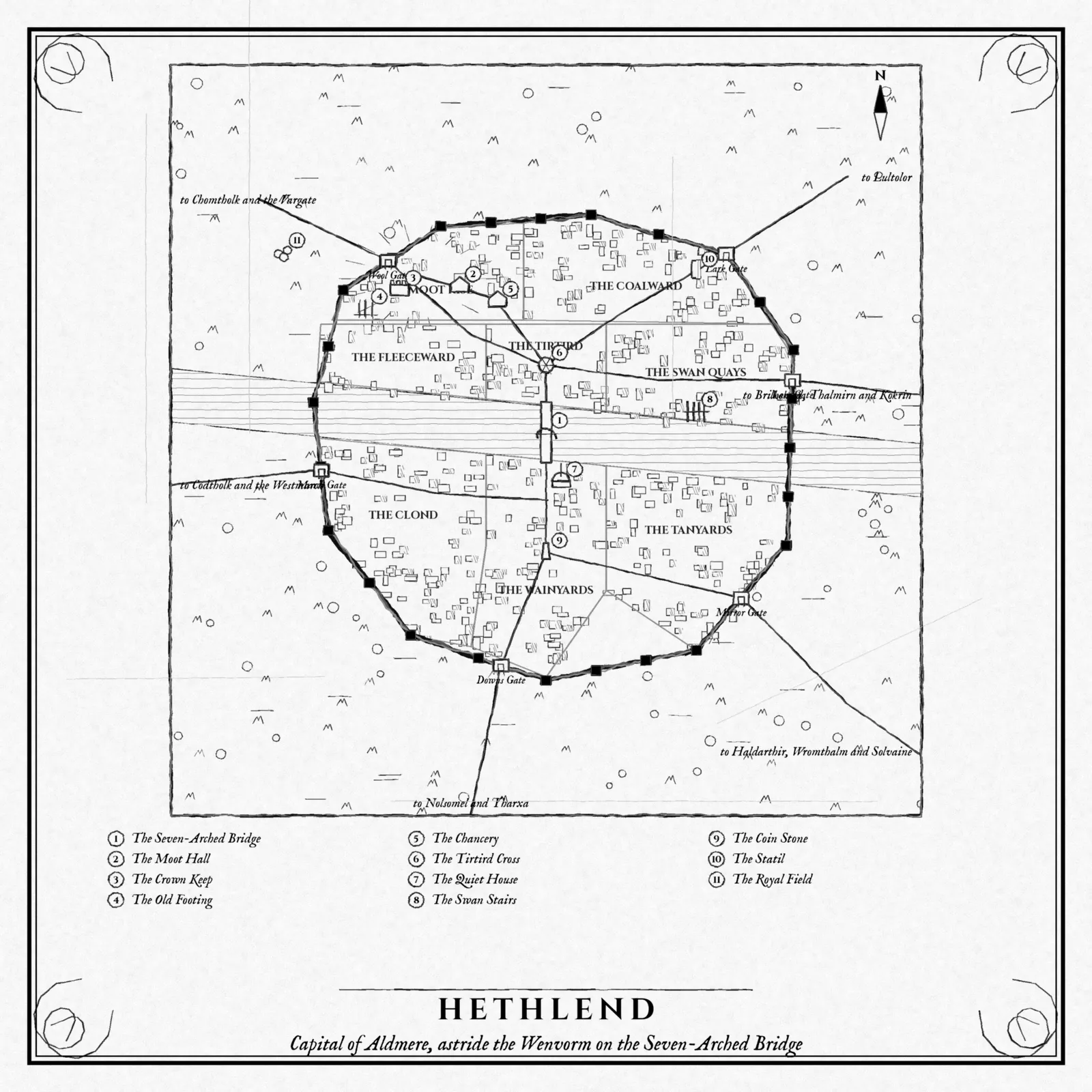
Map of Hethlend

Hethlend

Come up the Nolsomel road in late summer and you will smell Hethlend before you see it: malt from the brewhouses, hops on their poles in the river meadows, and, when the wind swings east, the tanyards. Then the road tops a rise, and there lies the city on both banks of the Wenvorm, one gray wall thrown around two halves of a town, and the seven arches of the bridge holding them together. Barges ride at the quays below it. The white specks on the water are the king's swans, and no man may touch them.

Read the full chapter on Hethlend →

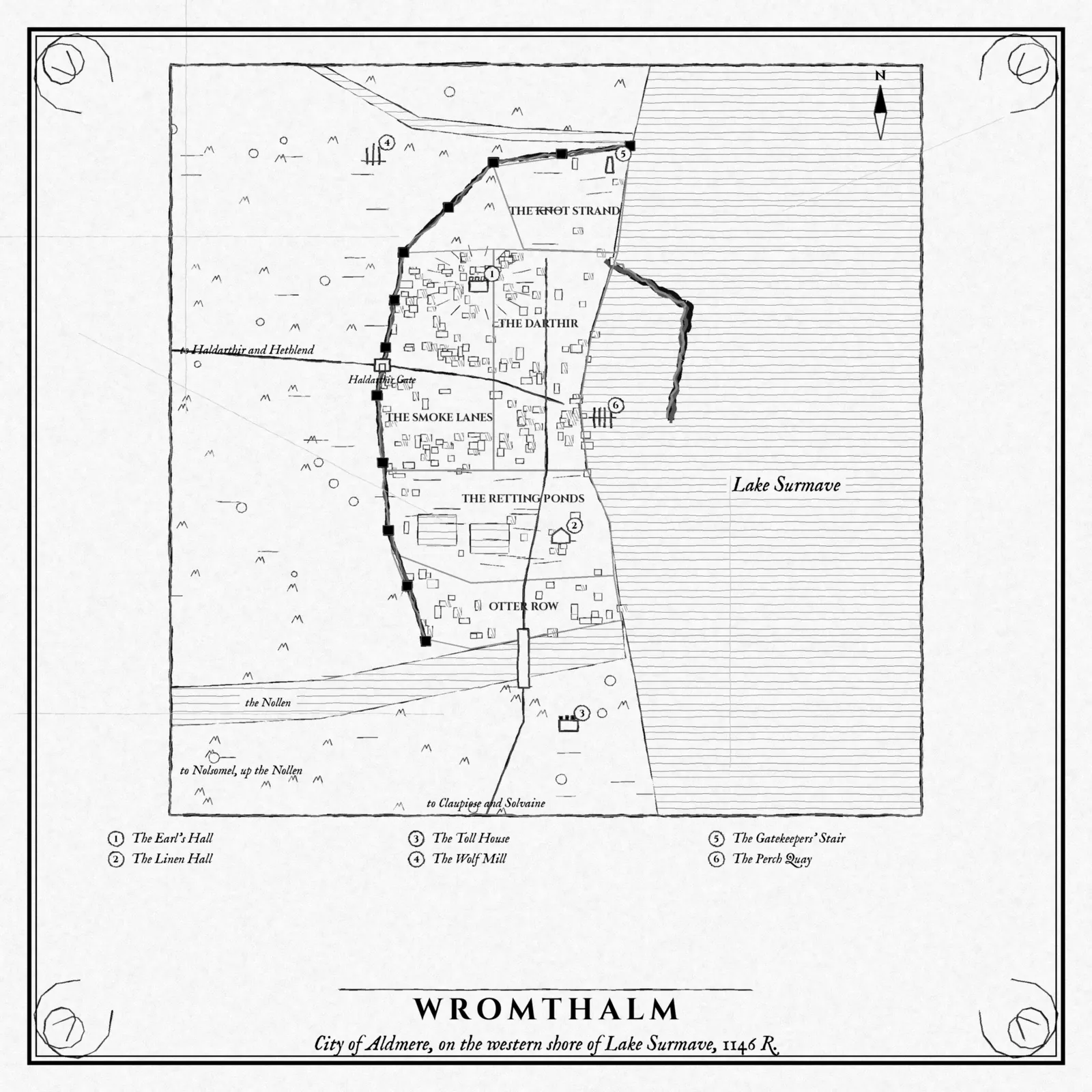
Map of Wromthalm

Wromthalm

From the Haldarthir road, Wromthalm shows itself as a long low town between the flax fields and the lake: a stone wall on the landward side, and on the water side nothing at all but quays, drying racks and smoke. The smoke is from the eel-houses, and on still days it hangs over the whole city. Past the roofs, Lake Surmave runs out gray to the edge of the world with no far shore. On a clear dawn, the fishermen say, a gold glint shows in the southeast, where the dome of the Sun Cathedral at Solvaine catches the first light.

Read the full chapter on Wromthalm →

Other towns and strongholds: Chomtholk, Lultolor, Nolsomel, Thalmirn, Codtholk, Haldarthir, Brilkemed, Kemvos, Wrunvos, Ownvos, Durtisir, Lulstat. Every town on the continent →

Great Houses and Armsdovind

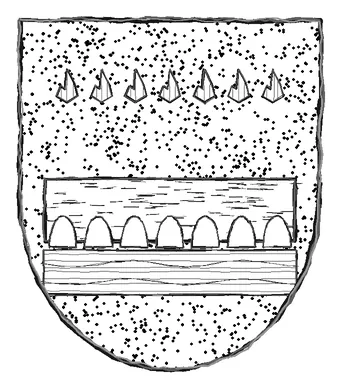
Arms of Tulvard

Tulvard

Hearth, Law, Harvest
Arms of Durift of the Westmarch

Durift of the Westmarch

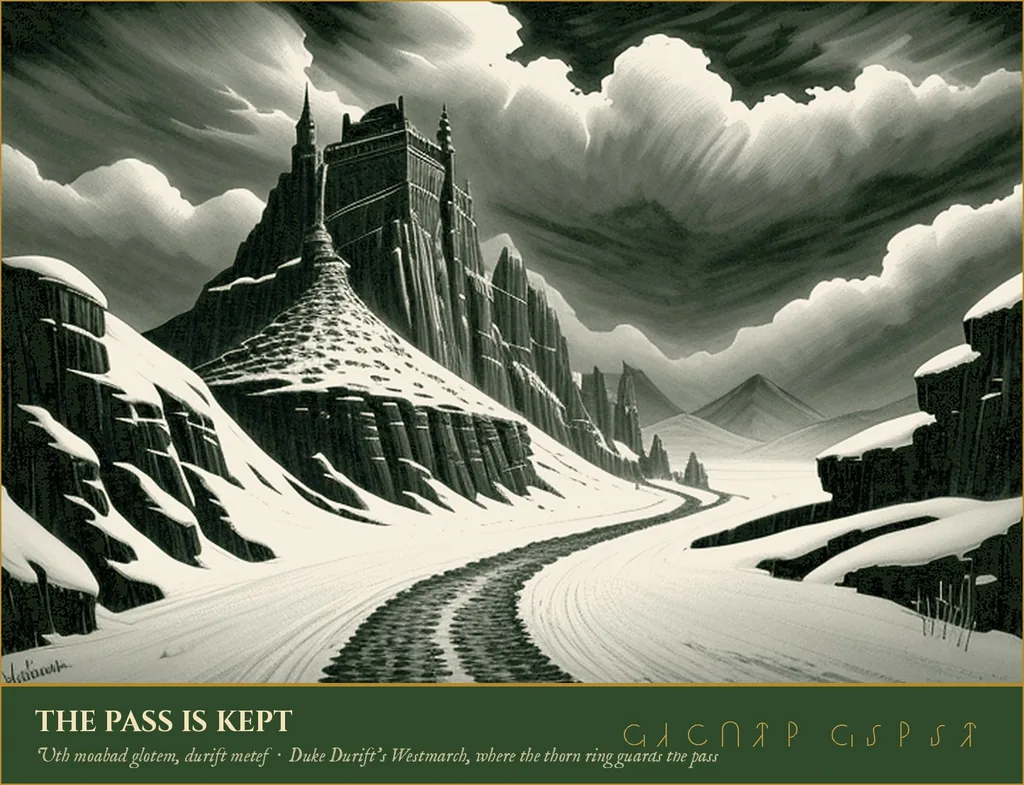
The Pass Is Kept
Arms of Ownirel

Ownirel

To the Mark
Arms of Coldbrook of the Vargate

Coldbrook of the Vargate

Both Sides of the Ridge
Arms of The Earls of Wromthalm

The Earls of Wromthalm

Ring for the Boats
Arms of The Earls of Thalmirn

The Earls of Thalmirn

Dry Land, Hard Won
Arms of Kewith of Ownvos

Kewith of Ownvos

Loose Together
The houses in full: descent, heads, heirs, feuds

Succession law

The crown goes to the king's eldest son. When there is no clear heir, the Moot chooses, as it did in 352 when Hethgrul II died childless and two cousins claimed the crown. A lord's fief passes whole to his eldest son, or to his eldest daughter if he has no son, and the younger children are owed a portion in goods or coin. A widow keeps a third of her husband's land for her life. A traitor's lands go back to the crown. By custom, not law, no Aldmere king is truly king until he has walked the seven arches of the Seven-Arched Bridge alone at dawn and the bridge has stayed silent. Every king has done it. Prince Hethbael has not.

The ruling house: Tulvard

text Hethbael, King of Vareth ═══ Sildith, Queen of Wessary (married 151) │ └── Hethmed Tulvard, first King of Aldmere, 178 │ ⋮ (the chronicles skip generations) │ ├── Hethgrul II, died 352 without an heir │ The Moot chose between two cousins of the house (unnamed); the line runs on through the chosen one ⋮ ├── Hethwur IV, signed the Charter of Hearths, 641 ⋮ ├── Princess Glaidith Tulvard ═══ Prince Tilaud diol Valcroix of Caelvenne (the Marriage of the Lake, 672) ⋮ ├── Hethminth III, won the Lords' War, 822–829 ⋮ ├── Hethlarn I, stabbed on the Moot floor, 996, and survived ⋮ (a Hethlarn II is implied by the numeral; the chronicles give no dates) │ └── (a king, unnamed, died of a fever, 1121) │ └── Hethlarn III "the Steady", born c. 1094, crowned 1121, the 31st Tulvard monarch │ └── Prince Hethbael, born c. 1122, crown prince

  • Seat: the Crown Keep on Moot Rise, Hethlend (hethlend); the Crownlands (the-crownlands).
  • Arms: the royal arms. Seven small flames stand in a row across the top of the shield, red on gold. Below them a gray stone bridge of seven arches crosses a blue river. A crown sits above the shield, and oak sprigs grow up either side.
  • Words: Hearth, Law, Harvest.
  • Head: King Hethlarn Tulvard III (52). He takes a week over every decision, and no one can name a bad one.
  • Heir: Prince Hethbael (24), who has called his father weak and Caelvenne a leech, in the Moot.
  • Wealth and power: The crown holds the Crownlands, the Chancery and its mint, the tolls of the six crown roads, the chain toll at Hethlend, and the 8,000 Crown Wardens. Against that, it owes the Vaides 850,000 leusores on the Compact debt of 511 and owes Farisel 2,100,000, and it pays about 139,000 leusores a year in interest.
  • Allies and feuds: The crown is bound to Caelvenne by the Grain Compact and to Tharax by the Bridge Treaty of 1052. The Westmarch serves it and does not love it. The Crownmen and the Southdowns stand behind the crown; the Mootmen stand behind the law.
  • History: The tree gives the dated kings. The old tale says the timber bridge groaned under every pretender and went silent under Hethmed Tulvard in 178. Hethminth III won the Lords' War only with Tharaxi mercenaries paid in Caelvennois gold. Hethlarn III came into two generations of debt to Farisel in 1121, and in 1146 his son asked him, before the full Moot, why Aldmere still pays interest on a loan made in 511.
  • Hooks: Someone paid the Chancery's archivists in leusores to copy the Vareth marriage rolls of the 600s, and those rolls hold the Marriage of the Lake. A Cherüsh letter offering alliance and a marriage is on its way to the prince, not the king. If the king falls ill, the Moot, the prince, the Chancellor and the Duke will each make ready in secret.
  • Direction: STABLE, under strain.

Durift of the Westmarch

  • Seat: Durtisir (durtisir), the fortress where the roads meet before the climb to Venei's Throat; the Westmarch (the-westmarch).
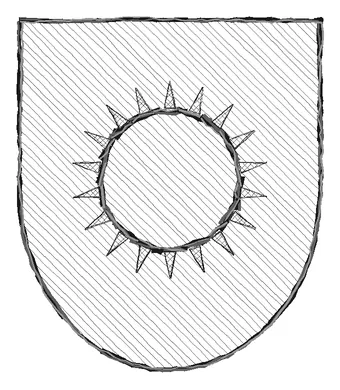
  • Arms: On green, a black thorn branch bent into a ring with its points turned outward.
  • Words: The Pass Is Kept.
  • Head: Duke Minthor Durift (47), warden of the western passes, with a Hrodvald axe-scar from mouth to ear, taken at Thalmirn in 1127.
  • Heir: The chronicles name none. By Aldmere law the duchy goes whole to his eldest son, or his eldest daughter if he has no son.
  • Wealth and power: Durift is the richest lord in Aldmere. By the Bridge Treaty the Westmarch keeps a third of the tolls of the Stair and Venei's Throat to garrison them, and the Duke keeps nearer half. His courts judge his own toll-men, and his toll-men are never found guilty.
  • Allies and feuds: The Duke is cousin to Grerik Coldbrook of the Vargate Clans. He is loyal to Aldmere, not to the Tulvards. The Westmarch has distrusted Hethlend since the Lords' War.
  • History:
  • 822–829 — Duke Yornbael Durift leads the Westmarch lords against King Hethminth III over the Moot's right to tax them. The Durifts keep their duchy, and the Moot keeps its taxes.
  • 996 — A Westmarch baron stabs Hethlarn I in the Moot hall. No weapon has been allowed there since.
  • 1052 — The Bridge Treaty gives the Westmarch the Stair and Venei's Throat to hold, and it grows rich on their tolls.
  • 1127 — Minthor takes his scar at the Hrodvald raid on Thalmirn.
  • Hooks: A Qaflan captain is waiting in Hethlend to complain that the Duke's toll-men took three times the crown's rate at Venei's Throat and killed a driver. The Duke would make a fine king. That is the trouble.
  • Direction: RISING.

Ownirel

  • Seat: The Chancery on Moot Rise, Hethlend (hethlend). The house holds no land.
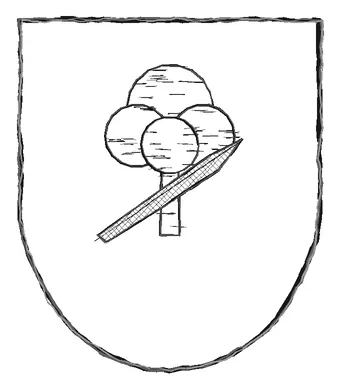
  • Arms: On white, a gray ash tree with its roots showing and a black quill laid across the trunk.
  • Words: To the Mark.
  • Head: Lord Chancellor Tuvith Ownirel (61), keeper of the treasury for twenty-two years.
  • Heir: None. She has no family, and the house ends with her.
  • Wealth and power: The house has no money of its own, and more power than any house in Aldmere but the crown's. The Chancellor keeps the kingdom's books, the Moot's rolls and every shire's tax rolls, and she knows which lords cheat on their taxes.
  • Allies and feuds: She is the patron saint of the Mootmen, though she would never say so. She quietly agrees with the Clearance, and she thinks it would bankrupt the kingdom.
  • History: Tuvith Ownirel took the Chancery about 1124.
  • Hooks: When the Valcroix claim to Vareth reaches the Moot, she will have three days to find the paper that answers it. On the night of his question she showed the prince the real ledger.
  • Direction: STABLE for as long as she lives, and then VANISHED.

Coldbrook of the Vargate

  • Seat: The Vargate Clans' country in the eastern foothills of the northern Spine (vargate-clans-country).
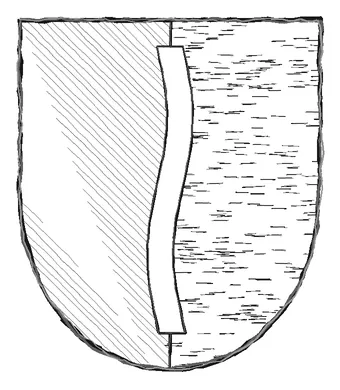
  • Arms: Split down the middle, green on the left and gray on the right, with a white stream running down the line between.
  • Words: Both Sides of the Ridge.
  • Head: Grerik Coldbrook, chieftain of the three Vargate Clans, about 6,000 people.
  • Heir: Not named. The Coldbrooks choose among their kin in the Hrodvald way.
  • Wealth and power: The clans sell timber and take a toll of half a mark on every wagon that passes the Vargate. The Coldbrooks raid nobody and toll everybody.
  • Allies and feuds: The Coldbrooks are no lords of Aldmere, but marriage binds them to it. Grerik is Duke Durift's cousin and Thuba Nugag's brother-in-law. The clans marry their daughters into the Northmere lords and Clan Nugag, and they and the Dunmorrow are the three corners of the northern Spine's trade.
  • Hooks: A Coldbrook rider goes up to Ironjaw Hold every month. Nobody knows whether he carries word for Kruman or about him.
  • Direction: STABLE.

The Earls of Wromthalm

  • Seat: The Earl's Hall above the Darthir, Wromthalm (wromthalm).
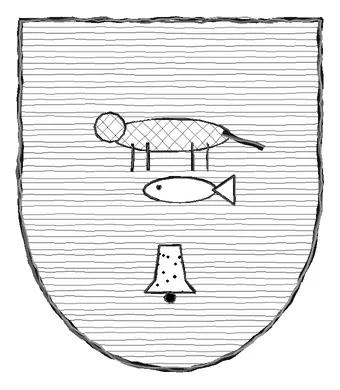
  • Arms: On blue, a brown otter holding a silver eel, above a small gold bell.
  • Words: Ring for the Boats.
  • Head: The Earl of Wromthalm, an earl of the crown, who governs with the town's elected reeve.
  • Heir: Not named.
  • Wealth and power: The earl's town lives on linen, smoked mere eel, otter pelts and the Caelvenne road. The crown's Toll House stands in his town, and Aldmere's debt to Farisel is pledged on its tolls, so the earl sits beside the one building in Aldmere that Solvaine watches hardest.
  • Allies and feuds: The earl's town faces Caelvenne more than Hethlend, and many of its families have a cousin in Claupiose.
  • Hooks: The earl has locked the Wromthalm fishermen's carved black stone in his hall, and three courts want it.
  • Direction: RISING.

The Earls of Thalmirn

  • Seat: Thalmirn (thalmirn), chief town of the Northmere (the-northmere).
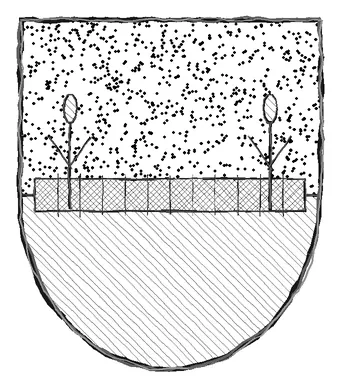
  • Arms: Gold over green in two level bands, with a black dike-wall across the middle and a reed standing on either side.
  • Words: Dry Land, Hard Won.
  • Head: The Earl of Thalmirn, a lakeshore earl of the crown and first among the Northmere lords.
  • Heir: Not named.
  • Wealth and power: The earls grow wheat on new ground. Thalmirn's new dikes are draining the Northmere marshes, and the Marsh Reeds with them, and every acre drained is the earl's.
  • Allies and feuds: The Northmere lords marry the daughters of Clan Nugag and the Vargate Clans. Some of Aldmere's Sun-Turners live on their lands.
  • History:
  • 1089–1127 — A generation of Hrodvald raids empties the northern shires.
  • 1127 — The raid on Thalmirn. Duke Durift takes his scar here and Kruman Ironjaw loses an eye. At last the crown fortifies Lulstat and the Northmere.
  • Hooks: A Northmere house with a Nugag bride now has kin on both sides of any war between Selra and Kruman. The Marsh Reeds have never paid a tax, and the dikes will make them pay in land.
  • Direction: RISING.

Kewith of Ownvos

  • Seat: Ownvos (ownvos), in the heart of the Southdowns (the-southdowns).
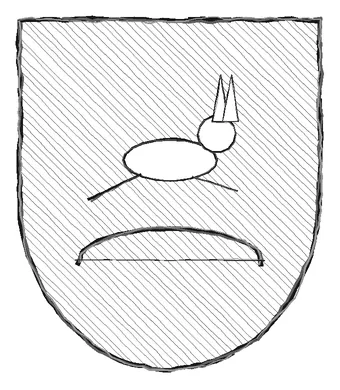
  • Arms: On green, a white hare leaping over an unstrung yew bow.
  • Words: Loose Together.
  • Head: Gunras the Hare-Lord, a lean gray lord of sixty who still shoots at the straw hare on Bow-day.
  • Heir: His eldest daughter, since he has no son.
  • Wealth and power: The house lives on sheep and yew. The Kewiths are the first lords of the downs, and the village archery guilds bring their longbowmen to the crown's levy under the Kewith banner.
  • Allies and feuds: The Kewiths are Crownmen to the bone: the king should rule and the Moot advise. They dislike the Marchers and like Prince Hethbael, who has not yet claimed them.
  • Hooks: Dunt Wrunvos's company, lent to Caelvenne under the Grain Compact, marches from Kewith land to Larvir.
  • Direction: STABLE.

Aldmere's nobility is STABLE, under strain. The crown stands on the Moot and the Chancery, not on its lords, and the one lord strong enough to challenge it, Durift, has no reason to while the tolls flow.


Faith, Myth and Folklorewurick

Myths

The First Fire. Before the Seven Hearths there was one fire, kept by a woman called Old Mother Ember in a hut on the Wenvorm.

The First Fire. Before the Seven Hearths there was one fire, kept by a woman called Old Mother Ember in a hut on the Wenvorm. Seven travelers came to her door on one winter night, each bringing nothing and asking for warmth. She split her one fire seven ways and gave each a coal, and the coals became the Hearths: Home, Harvest, Forge, Road, Healing, Law, and the Quiet one, which the seventh traveler, who was Death, carried off without a word. Old Mother Ember froze by morning at an empty hearth. That is why every Aldmere house leaves a coal burning overnight: so she is never cold again.

The Bridge That Chose Its King. When the Vareth and Wessary thrones were joined in 178, the old timber bridge at Hethlend was said to groan under any pretender who crossed it and to go silent under Hethmed Tulvard. The stone bridge that replaced it in 244 is said to keep the habit. No Aldmere king is truly king until he has walked its seven arches alone at dawn and the bridge has not spoken. Every one has done it. Hethbael has not yet.

The Sleeping Reeve. A burgher-reeve of Chomtholk, so the Moot's clerks say, fell asleep during a debate in the year 352 and slept through the vote that made the Moot itself. He sleeps still, somewhere under the Moot hall, and if he ever wakes, the Moot's authority ends. Clerks knock three times on the hall floor before every sitting, "to let him sleep."

Folk tales

Wemm of the Downs and the Hundred Arrows.

Wemm of the Downs and the Hundred Arrows. A Southdowns boy shot a hundred arrows at the moon to win a girl, and the hundredth stuck. On clear nights, the Downs say, you can see it. The girl married a miller.

The Miller's Wolf. A plain wolf came to a Wromthalm mill every winter for bread and was fed for twenty years, until the miller's son, home from a lord's war, shot it on the step. The mill wheel stopped that day and has not turned since, and the ruin is still shown to travelers.

The Reeve Who Counted Everything. A comic tale, told a hundred ways, about an Aldmere clerk who tried to count the stars for the tax rolls and is still counting. Any tiresome official is "counting stars."

Old wives' tales

  • Never let a hearth go fully cold in winter; Old Mother Ember will come sit in it, and she brings the frost.
  • A swan on the Wenvorm with its neck turned toward Hethlend means the king will hear bad news.
  • Bread that rises crooked has been breathed on by a Gray Choir singer passing the window.
  • Do not whistle on the bridge; the arches count the notes, and the seventh belongs to the Quiet Hearth.
  • A Moot owl heard at noon means a lord will die before the harvest. A Moot owl heard at midnight is just an owl.
  • Put a coin on a Hearth-keeper's doorstep after a birth, or the child will always be cold-handed.

Traditions

  • Hearth-lighting. A new house is not lived in until a coal from a neighbor's hearth has been carried to it. To sell a house without one is bad luck for the seller.
  • The Reeve's Loaf. On Moot day every town bakes one loaf for the hall, and the poorest man present cuts it. The king eats last.
  • Bow-day. Every Southdowns boy, and in the last hundred years most girls, is given a child's bow on the first day of spring and shoots at a straw hare. If the hare is hit, the village guild's hare-tattoo comes at sixteen.
  • Quiet Hearth night. On the longest night, families sit in the dark for an hour with the hearth banked and name their dead aloud. It is the one Aldmere rite the Berrode of Castavar has tried to condemn and failed.

Law and Daily Lifetuvad

Courts, crimes, marriage, food, dress and a day in Aldmere

Law

A law must pass the Moot of great lords and elected burgher-reeves. The king can refuse a law, but he cannot make one alone. The Moot sits at Hethlend from the 1st of Halshul, and its new laws are read from the steps of the Tirtird Cross and then in every shire town.

Law is judged at three levels. The crown's judges sit in the Law Hearth's hearth-house in Hethlend, and twice a year they ride the crown roads to sit a week in each shire town, where every hanging case waits for them. On a fief the lord holds court for his tenants in anything short of a hanging. In a village the reeve settles boundaries, strays and small debts in the Harvest hearth-house. Courts sit on Law-day, Tuvad, and never in the Accord Days, and oaths are sworn with a hand on the stones of the Law hearth. Duke Durift's Westmarch is the exception everyone complains of: his courts judge his toll-men, and his toll-men are never found guilty.

The watch. The Crown Wardens, some 8,000 paid men, answer to the crown alone. Towns keep watches of guildsmen serving in turns under their reeves. A village has no watch. The reeve blows a horn and every grown man turns out, or pays a fine.

Crime Usual punishment
Petty theft A day in the pillory and the goods returned
Theft above a crown's worth A fine of twice the value, or banishment from the shire
Short weight in a market A fine; the false weights are broken on the market cross
Brawling, dice with shaved corners A fine in marks
Killing one of the king's swans A crown a bird
Poaching a Nollen deer Hanging
Arson inside a town wall Hanging
Murder Hanging, after the crown's judges have heard it
Drawing steel in the Moot hall Death, since 996
Treason Hanging, and the family's lands revert to the crown

Banishment and outlawry. Banishment is common and cheap. The sentence is read at the market cross, and the banished man is walked to the edge of the shire or, from Hethlend, across the bridge and out the Downs Gate. If he comes back before his term, he is hanged without a new trial. Under the Charter of Hearths of 641, a Bound man from Tharax is free the moment he touches Aldmere soil. Tharax has never accepted it.

Debt. Moot law holds interest between Aldmeri to one coin in ten a year. Foreign lenders are not bound by it, and that is how the crown has come to owe Caelvenne since 511. A debtor who cannot pay works the debt off for his creditor, for a term the reeve sets. Aldmere keeps no debtors' prison and thinks Solvaine's Hulks a disgrace.

Family

Marriage and divorce. A couple marries before the keeper of the Home Hearth, each saying yes aloud, and anyone under eighteen needs a parent's word as well. Most village weddings fall in Halshul and Wrunim, after the harvest and before the snow, and the couple will not sleep in their new house until a coal has been carried to it from a neighbor's hearth. Lords marry for land, and of late the northern lords have married the daughters of Clan Nugag and the Vargate Clans. The Law Hearth's judges will part a couple for cruelty, for desertion, or for a marriage "gone cold" once the two have lived apart a year and a day, and each takes back what they brought.

Inheritance. A tenant's holding and a lord's fief both go whole to the eldest son, or to the eldest daughter if there is no son, and the younger children are owed a portion in goods or coin. A widow keeps a third of her husband's land for her life. The crown passes to the king's eldest son. When there is no clear heir the Moot chooses, as it did in 352.

Women. An Aldmere woman may own land, run a guild, trade in her own name and hold office. Hethlend's Bridge-Reeve is a woman, and so is the Lord Chancellor. In the Southdowns most girls now get a child's bow on Bow-day along with the boys.

Who is not free. Nobody in Aldmere can be owned or sold. Tenants owe their lord labor days and a share of the harvest, and may leave at Harvest Home once their debts are paid. Few do. The next lord asks the same.

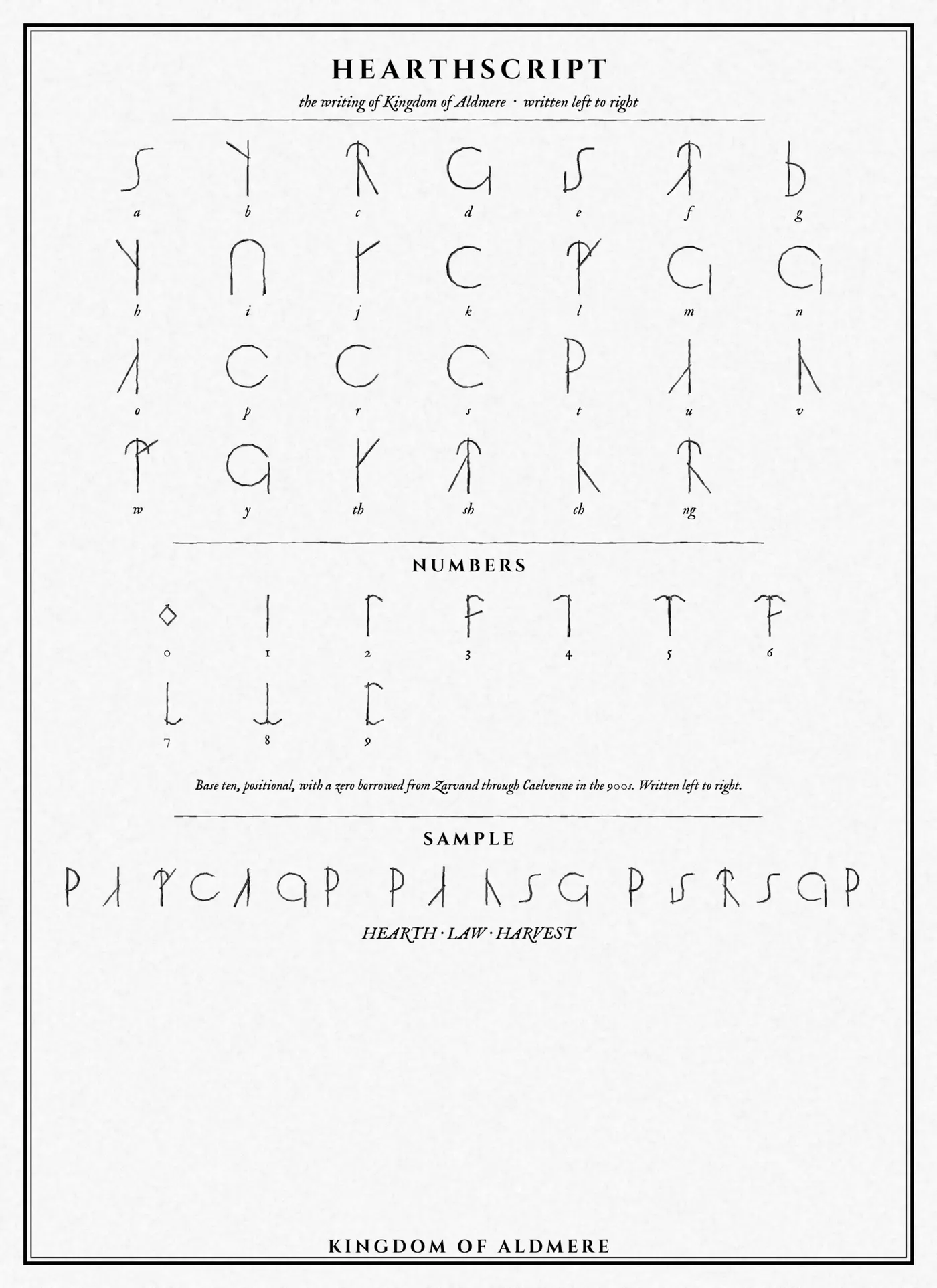
Children and schooling. About one Aldmeri in five can read, more in the towns. Market towns keep Hearth schools, where a Hearth-keeper teaches Hearthscript and the ledger figures for a few eighths of a mark, and the brightest go on to the Chancery as clerks. Most children learn a trade. An apprentice is bound to a master for seven years, one for each Hearth. A clever Aldmere boy goes to Solvaine or Mazbaaran, and often he does not come back.

Daily life

Food and drink. In the towns bread is Crown wheat. In the villages it is wheat mixed with Chomkel barley. Ale is drunk at every meal, and the big meal of the day is taken at midday.

A lord on Moot Rise A Coalward nailer A Southdowns tenant
Morning White bread, cold mutton, ale Bread and ale Wheat-and-barley bread, ale, a Hearth apple
Midday Wenvorm trout, roast Chomkel mutton or Nollen venison, honey cakes, mead or Ienvaune wine A pie from a Tirtird stall, or smoked mere eel, with ale Pea pottage with bacon on good days, cheese, ale
Evening Pike or capon, cheese, cider from the west Bread, cheese and ale; meat twice a week Bread and cheese; a Downs hare when a bow finds one

Dress and houses. Everyone wears wool, and color tells rank: undyed or brown for laborers, blue and green for guild families, red for lords. Wromthalm linen goes next to the skin of anyone who can afford it, otter-lined cloaks mark great wealth, and Caelvennois silk is worn on Moot Rise and mocked everywhere else. Villages are timber frame, wattle-and-daub and reed thatch. Towns forbid thatch and roof in slate or tile, and lords live in stone keeps. In every house a coal burns through the night.

Health and hygiene. Aldmere heals with its hands, and heals well. Each town's Healing hearth-house sets bones, lances boils and sells Hearth-bee honey for wounds and coughs, and bonesetters travel the shires. The best known in the Crownlands is Lasmod the Bonesetter (lasmod, "kind"), who charges a mark for a leg and nothing for a child. Physicians trained in Mazbaaran serve the great lords. Tirtird herb-sellers sell Gap gentian root for the stomach and wormwood of the Sands for fever, and every child is taught the nightcap mushroom and the berries of the Downs yew. People wash in the river above the towns and never drink it below the tanyards.

Birth and death. The family of a newborn puts a coin on the Hearth-keeper's doorstep, or the child will always be cold-handed, and names the child at its own hearth on the first Quiet-day. The dying are nursed in the death-hearths of the Quiet Hearth. The dead are buried behind the village hearth-house, and on the first night the hearth at home is banked, not put out. On Quiet Hearth night, the 6th of Tulront, every family sits in the dark for an hour and names its dead aloud.

Pastimes. Dice are everywhere, and archery butts stand outside every gate. Summer brings boat races and tumblers. Autumn brings the cart-plays, and the one the crowds love best is the clerk who tries to count the stars for the tax rolls. At Harvest Home the villages dance to pipe and drum.

A day. A village family eats bread and ale at first light, works the strips until the big meal at midday, and works again until dusk. The week runs through the seven Hearths from Somald to Tunnath, and on Quiet-day nobody plows.

Where it is going: STABLE, under strain. Aldmere's law works because it is slow, done in the open, and heard by judges who ride the same roads every year. The strain is at its edges. The Charter frees Bound runaways whom Tharax wants back, the Gray Choir refuses to sow winter wheat, the Westmarch keeps its own courts, and the crown pays interest that a Moot law would forbid between neighbors. A law that takes a week to decide anything must now keep pace with 1146, and no one can say yet whether it will.


Trade, taxes and money

Makes and sells. Crown wheat above all, some ten million bushels a year of it to Caelvenne. Chomkel wool comes second. Then cattle, ale, linen, smoked eel, otter pelts, timber and iron goods, and grain to Tharax in bad years.

Buys. Glass, silk, perfume, wine and credit from Caelvenne; Castavari red, destriers and salt; Zarvani paper and spices; Dunmorrow steel; Frostmarch furs.

Taxes and tolls. - The hearth-tax: one mark a year from every hearth, paid at Harvest Home. About 80,000 crowns. - The Moot's tenth: a tenth of movable goods in the towns and a fifteenth in the shires, when the Moot grants it. It was granted in eleven of the last fifteen years and brings in about 240,000 crowns. - The wool-crown: one crown on every sack of wool that leaves the kingdom, about a tenth of what the sack fetches at the Fleeceward. - Crown road tolls at every crown toll-house: an eighth of a mark for a laden pack-beast, half a mark for a laden cart, a quarter mark for each head of cattle. The Toll House at Wromthalm is the busiest. - Pass tolls at the Vargate, Venei's Throat and the Stair, at the crown's rate of one mark a pack-beast and three a wagon. By the Bridge Treaty the Westmarch keeps a third of the Stair's and the Throat's tolls to garrison them. Duke Durift keeps nearer half. - The chain toll at Hethlend: one mark for every barge that passes the chain towers. - The mint charge: one mark in forty on silver struck at the Chancery. - Crown lands, forests and fines bring in about 200,000 crowns more.

Direction. STABLE, under strain. The whole continent needs Aldmere's grain, but a fifth or more of the crown's income goes to Solvaine.

The Year in Aldmerefurock

Months. Farmers' months: Chomark (harrow), when the plowing starts, Larrel (lark), Bredild (flower), Gleor (sun), Serleck (wool) for the shearing, Tengant (harvest), Halshul (mill), Wrunim (fallow), when the fields rest, Monmit (ember), Tulront (hearth), Bonsirm (snow), Spirmar (hare).

Week. Seven days, one for each of the Hearthfaith's seven Hearths: Somald (Home), Tengant (Harvest), Mawel (Forge), Totid (Road), Prilen (Healing), Tuvad (Law), Tunnath (Quiet). Quiet-day is the day of rest. The week runs straight on through the months and the Accord Days, so a date falls on a different weekday each year.

Years. The Reckoning. The Moot's rolls give the king's year of reign as well.

Festivals:

Speak Aldmeridilned

Aldmeri English
Tothsal tulront. Hello. (Literally "good hearth.")
Larnerd tulront. Goodbye. (Literally "peace, hearth.")
Hwar urm uth slalend? Where is the bridge?
Esh nuth yinsesk. I don't know.
Hwu nulk? How much?
Uth hethrin drunin uth tuvad. The king keeps the law.
Yeth, heldor. Neeth, heldor. Yes, my lord. No, my lord.
Keedil ith dolang, elsosk. Say it again, please.
Esh urm oam clond yent. I am a stranger here.
Plal yoth tharl? Do you have bread? (The verb comes first in a yes-or-no question.)
Hosk cundud eshum uth pladis. He gave me the sword. (Past tense: -ud.)
Wost yeld pemid uth trulith. We will open the door. (Future: yeld before the verb.)
Uth thadernow bethen laillen. The horses eat grain. (Plural: -ow.)
Uth hethriney slalend The king's bridge. (Possessive: -ey. Shortened, this is the capital's name, Hethlend.)
Tulront, tuvad, tengant. Hearth, law, harvest. (The royal motto.)
AldmeriEnglish
duvickperson
wromerfather
voosthusband
hethrinking
shulritfarmer
gleorsun
diswothwind
thalmlake
seemirnwood (material)
dunsalftown
trulithdoor
nalatday
doorborspring
tharlbread
sadimwine
rabarthdog
thaliftbird
gasreldnephew
gotelkparent
seemirnardcarpenter
glairhealer
bonindmaster (of a house or craft)
bowduldhail
guvockplain

The full Aldmeri dictionary

The script of Aldmere, with numerals and a sample line

Great Worksgeesin

Aldmere writes the way it plows, in straight lines and for use: its great books are rolls, charters and sayings kept by clerks and Hearth-keepers in round Hearthscript, and a clever Aldmeri who wants to be a poet usually goes to Solvaine and does not come back. What the kingdom loves it sings, laughs at from the back of a cart, or reads aloud at the Moot, and it has been quoting the same few pages at itself for eight hundred years.

Chronicle · chronicle

The Long Book of the Moot

Uth Privemey Lird Geesin “the moot's long book”
Dilnard of Kemvos, and every clerk of the Moot after him · 352 R. to the present

The running record of every sitting of the Moot since the first, kept at one page a sitting in the Chancery's plain Hearthscript: who came, what was argued, what passed, what the king refused. Dilnard's first page records the choosing between the two Tulvard cousins in 352 and, in one line, the reeve of Chomtholk who slept through the vote. Later clerks kept his habit of writing down what happened and not what anyone wished had.

Oam taweld vood Chomtholk frirlosud, uld wost nuth frolornud hoskum.A reeve from Chomtholk slept, and we did not wake him.
Its author, and how it lives now

Dilnard of Kemvos, and every clerk of the Moot after him. A Westmarch goatherd's son who learned letters from a Hearth-keeper and was the first clerk of the Moot in 352; he died in office in 389.

Kept in the Chancery on Moot Rise, nearly eight hundred pages and still growing; Dilnard's first page is read aloud each 1st of Halshul after the clerks knock three times on the floor. The entry for 1103 records the Chancery's answer to the Moot's wager on the Two, which settled nothing and is quoted by both sides.

Faith · book of sayings in seven parts

The Seven Embers

Vurn Monmitow “seven embers”
Wurith of Codtholk · c. 460 R.

The nearest thing the Hearthfaith has to scripture, and it would object to the word. It opens with the tale of Old Mother Ember and the seven travelers, then gives one short book of sayings for each Hearth, from Home to the Quiet Hearth, most of them practical: bank the fire, pay the reeve, bury the dead behind the hearth-house, carry a coal to a new house. The book of the Quiet Hearth is the shortest and says the least, on purpose.

Vurn tulrontow, oam baeld. Nuth lirir uth tulront vowth.Seven hearths, one fire. Do not leave the hearth cold.
Its author, and how it lives now

Wurith of Codtholk. Hearth-keeper of the Home hearth at Codtholk for forty years; she gathered what the village keepers of the Crownlands said and wrote it down so it would stop changing.

Every village hearth-house has a copy, and a Hearth-keeper reads the day's book aloud on its Hearth's day of the week. The Gray Choir reads the Quiet Hearth's book as a prophecy; Sister Tunith reads it as a set of instructions for nursing.

Learning · royal charter

The Charter of Hearths

Tulrontowey Tuvad “the hearths' law”
King Hethwur IV and the Moot · 641 R.

A law of one page that lets every man in the kingdom worship as he will, and holds that a Bound man is free the moment he touches Aldmere soil. It was written for the refugees the Hunger Wars and the Reasoned Purge had left on Aldmere's roads, and it is why the Clond exists. Aldmere's lawyers say it is the finest thing the kingdom ever wrote because it is so short there is nothing in it to argue about; they have argued about it for five hundred years.

Lail duvick olk thek thritin urm birnoth, uld mosk wuft tulk hoskey thalk ethrom.Every person on this soil is free, and may pray to his own god.
Its author, and how it lives now

King Hethwur IV and the Moot. The Tulvard king who married Princess Diznesh of Zarvand in 633; Zarvand says the Charter was her doing, and Aldmere says it was the Moot's.

Read from the steps of the Tirtird Cross, and then in every shire town, whenever a king is crowned, and cut into the Law hearth's stones at Hethlend. Tharax has never accepted it, the Office of Truth has asked for the names it shelters, and a Bound runaway who reaches Kemvos can usually recite the line above.

Poetry · ballad

Wemm's Song

Wemmey Desack “Wemm's song”
Anonymous; set down by Larrith of Ownvos · sung before 700 R.; written down 758 R.

The Southdowns ballad of Wemm, the boy who shot a hundred arrows at the moon to win a girl, one verse to each ten arrows and a refrain the whole alehouse takes up. The hundredth arrow sticks, the girl is won, and in the last verse she marries a miller anyway, which the Downs regard as the point. Larrith's text is the one the archery guilds teach.

Oam murd flainow tulk uth silden, uld uth doosod druninud.A hundred arrows to the moon, and the last one held.
Its author, and how it lives now

Anonymous; set down by Larrith of Ownvos. A Southdowns bowyer's widow who wrote the ballad out in 758 because, she said, every village was singing it wrong in a different place.

Sung on Wemm's Night at Ownvos mill and on every Southdowns butts; the Crown Wardens' longbowmen march to it, and sing it on the Statil's roof on Wemm's Night, where they are fined every year for the shooting and never for the song. Ownvos keeps Larrith's copy in the Stave House, where it is dry.

Stage · cart-play (comedy)

Counting Stars

Uth Glailalowey Yeenid “the stars' tax”
Kisard of Lultolor · 1131 R.

The old comic tale of the clerk who set out to count the stars for the tax rolls, fixed at last as a cart-play in three short acts. The clerk counts through the night, loses his place at every owl, charges the moon a hearth-tax, and is still counting when the sun comes up and his lord asks for the total. Every town played it its own way for three hundred years; Kisard's text is the one the autumn carts now carry.

Hwu nulk glailalow? Gork, heldor. Hoork gork.How many stars? Tomorrow, my lord. Always tomorrow.
Its author, and how it lives now

Kisard of Lultolor. A Chancery clerk dismissed in 1131 for writing it on the Chancery's paper; he died a carter's partner in 1140 and was buried at Lultolor with a tally-stick.

The best-loved cart-play of every Aldmere autumn, performed from wagon-beds in the Tirtird and every market square. Any slow official is said to be counting stars, and the Chancery is still annoyed about the paper.

Song · hymn

The Dawn Song

Uth Cobashey Desack “the morning's song”
Drerith of Chomtholk · c. 1104 R.

The one song of the Gray Choir, sung in the streets at every dawn, which teaches that the Quiet Hearth is going out, that the Great Winter was its first sign, and that the singers must give away what they own before the fire fails. It has seven verses and no ending; the singers begin again. Its tune is an old Chomkel harvest round, which is why farmers who hate the Choir find themselves humming it.

Uth tunnath tulront tald thust; wost hend gasest uth gleor.The quiet hearth grows dark; we sing before the sun.
Its author, and how it lives now

Drerith of Chomtholk. A Chomtholk weaver who lost her family in the Great Winter raids and was the first to wear gray; she gave away her looms and died in 1119, singing, the Choir says.

Sung at dawn in Chomkel by some twenty-five thousand people and in Hethlend's Tirtird by a few hundred; lawful under the Charter, forbidden inside the wool halls, and blamed by the grain factors for the unsown winter wheat. Nobody in Chomtholk can say whether it is a hymn or a warning, and the Moot has stopped asking.

A Thousand Yearssishang

YearWhat happened
0 R.The Accord of Surmave. The six surviving great powers and the Tharaxi sign the Accord on an island in Lake Surmave, fixing borders and founding the calendar: Vareth, Wessary, the Marrowmere League, the Twin Crowns of Castavar and Lasdara, the Sarvani Khaasarate, the Three Thrones of the East, and Tharax. Hrodvald sends no envoy and signs nothing.
0–146 R.The Accord holds. The Accord holds, mostly. Vareth and Wessary spend the first century marrying into each other's royal houses. The Sarvani Khaasareem dig the first great salestoot. The Three Thrones fight each other every generation. Tharax, having lost half its citizens in the Century of Fire, rebuilds the Anvil.
97 R.A Vareth–Wessary marriage. Prince Hethnol of Vareth marries Princess Glailith of Wessary, the first of the century of marriages between the two royal houses that ends in the Union of the Heartlands. The Wessary claim to the Wenvorm's southern bank enters the Vareth marriage rolls.
151 R.The Union of the Heartlands. The Union of the Heartlands. King Hethbael of Vareth marries Queen Sildith of Wessary. Their son, Hethmed Tulvard, becomes the first king of a united Aldmere in 178. The Tulvard dynasty has ruled Aldmere ever since.
160s R.The Gray Cough. The Gray Cough, a lung plague, sweeps north from the Sunmaw through the Heartlands and into the Frostmarch. A fifth of the Heartlands dies. Hethlend is abandoned for three years.
178 R.Hethmed Tulvard, first king of Aldmere. Hethmed Tulvard, son of King Hethbael of Vareth and Queen Sildith of Wessary, becomes the first king of a united Aldmere. The Tulvard dynasty has ruled Aldmere ever since.
231 R.The Hethlend Collapse. The Hethlend Collapse. The old timber bridge over the Wenvorm gives way during the spring flood, drowning three hundred, including Aldmere's Lord Chancellor. The seven-arched stone bridge that gives the city its name is finished in 244.
244 R.The seven-arched bridge finished. The seven-arched stone bridge that gives Hethlend its name is finished, replacing the timber bridge that fell in 231.
283 R.Fevar Red-Axe's raid. Hrodvald clans under Hearthking Fevar Red-Axe raid down the Fur Trail as far as Chomtholk. Aldmere builds the first fortress at the Vargate.
352 R.The Tulvard Succession. The Tulvard Succession. King Hethgrul II of Aldmere dies without an heir. Two cousins claim the crown. Rather than fight, the great lords convene the first Moot at Hethlend and choose between them. The Moot has met every year since and gradually took the power to make law.
432 R.The Frostmarch Famine. The Frostmarch Famine. Two failed summers. Hearthking Anoga Wolf-Mother, the first woman elected Hearthking, leads the clans south to buy grain from Aldmere instead of raiding for it. The precedent lasts a generation.
511 R.The Grain Compact. Aldmere and Caelvenne sign the Grain Compact: Aldmere feeds Caelvenne, Caelvenne lends to Aldmere. The Aldmere crown's debt to Caelvenne begins here and has never been paid off.
555 R.The Kingdom Under the Spine falls. The Kingdom Under the Spine falls. The Dunmorrow Underking Grarg the Proud refuses to sell steel to Castavar and Aldmere unless they pay in gold. Both realms besiege the Delvers' holds together. The Dunmorrow are never conquered, but their kingdom is broken; the holds go back to being independent clans, and they sell to everyone.
622 R.The Cinder Teeth erupt. The Cinder Teeth erupt. The largest volcanic event in recorded history. Ash falls as far as Hethlend. The sky is dim for a year.
623 R.The Year Without Summer. The Year Without Summer. Crops fail across Aethorra. The Frostmarch, the Heartlands and the Sunmaw all starve. Kaishon opens its granaries and survives better than anyone. The Hizkari, who lived on the slopes, become a hardened remnant people.
624–630 R.The Hunger Wars. The Hunger Wars. Hrodvald raids, Aldmere border wars, and a Castavari invasion of Zarvand for grain that ends in the desert. It is in these years that Zarvand first uses naphtha from the Cinder Teeth seeps as a weapon: Talodin fire.
626–627 R.The Rice March. The Rice March. In the Hunger Wars, General Dezau Kyarau leads thirty thousand conscripts out of the Jade Gate to escort Kaishon's rice convoys west and collect Caelvenne's silver. At the Tontanor fords, on the League's Day of the Accord Days, his repeating crossbows kill some three thousand Aldmeri levies and Caelvennois marines who had been taking the rice; that night the steppe tribes take it. Kyarau marches home in 627 with the silver, the only Kaishoni army to stand west of the Rampart since the Emptying. In the same season the Zarvani burn a Castavari column with naphtha on the salest channels below Kebidaan, the first Talodin fire.
631 R.The Peace of the Isle. The Peace of the Isle ends the Hunger Wars. The envoys of the six signer-realms meet on the Isle of the Accord in the Accord Days, the first time since 0 R. Five terms: a signer whose army crosses a border in the Accord Days loses its chair at the Isle for seven years, and Kaishon sits out the first penalty; no realm's soldiers may seize a Qaflan wheel or a Drift keel, the Road Terms; each signer sends an envoy every year to hear the Accord read, the seed of the Sitting; grain in transit is not spoil; and a price is not an act of war. Hrodvald is not asked.
633 R.Hethwur marries Diznesh. Prince Hethwur of Aldmere, later Hethwur IV, marries Princess Diznesh, daughter of Khaasar Zhurteer of Zarvand, in the wake of the Peace of the Isle. She brings a physician, paper for the Chancery and a fire-shrine to Moot Rise that is still lit. Zarvand says the Charter of Hearths of 641 was her doing; Aldmere says it was the Moot's.
641 R.The Charter of Hearths. Aldmere's Charter of Hearths, signed by King Hethwur IV, guarantees freedom of worship in the kingdom. Refugees from the Reasoned Purge and the Berrode's inquisition settle in the Heartlands.
672 R.The Marriage of the Lake. The Marriage of the Lake. Prince Tilaud diol Valcroix marries Princess Glaidith Tulvard of Aldmere. The Valcroix line has Aldmere royal blood from this point, and Caelvenne has never let Aldmere forget it.
801 R.The Black Autumn. The Black Autumn. A blight destroys the Heartlands wheat crop. Aldmere borrows a fortune from Caelvenne to buy Kaishoni rice. The Grain Compact debt doubles.
822–829 R.The Lords' War. The Lords' War. The great lords of Aldmere's Westmarch, led by Duke Yornbael Durift, rebel against King Hethminth III over the Moot's right to tax them. The king wins, barely, with Tharaxi mercenaries paid in Caelvennois gold. The Durifts keep their duchy; the Moot keeps its taxes. The Westmarch has distrusted Hethlend ever since.
892–899 R.The Ledger War. The Ledger War. After a rotted harvest, Aldmere's Moot halves the Compact measure for 891; the Conclave calls it a breach and seizes forty grain barges and the Drift town of Threeoars at the Wenvorm mouth (the Seizure on the Mirror). Caelvenne's old houses pay Castavar's King Gaduo I to march on Zarvand for the ransom silver of 868. Aldmere, Zarvand and Tharax swear the Compact of Wrunvos in the Seventh Month: no separate peace, Aldmere grain down the Tharax road, Zarvani horse to the lake, the Gap closed to Castavar, and Tharaxi spears paid in twenty years of grain, not gold. Castavar calls it no war, because the Rislo will not call it a crusade.
893 R.The Summer at Lokon. Refused the Gap, twelve thousand Castavari sit below the pass at Lokon from the Third Month to the Seventh and go home when the Grandees' silver runs short, having fought nobody. King Kraxor Deneskid takes six thousand spears north to Aldmere by the Stair; King Sperxor Sastorid holds the Gap with the Bound rolling stones. No army forces the Gap. Tharax names the year for it.
895 R.The Battle of the Darthir. The Battle of the Darthir. Caelvenne's galleys land the Lilies, four hundred Castavari knights and two thousand hired Hrodvald crews below Wromthalm to take the Toll House. Kraxor Deneskid's Phymun meet them on the shingle in silence, and three thousand Zarvani horse archers under Khusjiraad shoot the Lilies' horses in the harbor shallows. The Lilies break, the Hrodvald reach the galleys, the Castavari knights are ransomed at fifty larrama a head. Caelvenne holds the water and never lands on it again.
897 R.The Thalmirn Boats. Aldmere tries the lake once. Forty lakeshore boats with bolt-throwers, built through the winter by the Northmere lords to break the blockade of the Wenvorm mouth, are reported by the mirror towers the morning they are launched and burned at their moorings that evening by the Claupiose and Solvaine squadrons. Aldmere has not built a warship since.
899 R.The Ledger Peace. The Ledger Peace, sworn on the Isle of the Accord in the Accord Days after a year of Qaflan wheel-letters, with Kaishon's ambassador as go-between. The Grain Compact is restored word for word and the measure is to be set each New Year's Day by Moot and Conclave together; the barges of 892 are paid at the Compact price and the Drift paid a leusore a keel for Threeoars; Castavar's chair at the Isle, empty since 895 for crossing into Daalher on the Khaasar's Day of 894, stays empty to 901 and Castavar swears the Peace standing and gets nothing else; Zarvand keeps Daalher and doubles its gate; Tharax takes its twenty years of grain and resolves never to be paid in gold, a resolution kept until 1131; and the Qaflan and the Drift are given a bench in the Sitting's hall to swear the Road Terms on, which becomes the Bench of the free peoples. Princess Somith Tulvard marries Prince Corenvo of Castavar to seal it. The sentence assigning the banks of the Tsanha fords is written badly, and the War of the Tsanha Fords is fought over it in 911.
903 R.The House of Farisel founded. The House of Farisel is founded in Solvaine by a glass-merchant's widow, Vailine Farisel, who lends to Aldmere's crown when the older houses refuse. Within a century Farisel holds the debts of half the continent.
911–914 R.The War of the Tsanha Fords. The War of the Tsanha Fords. Aldmere and Caelvenne fight a short war over who controls the crossing where the Tsanha leaves Lake Surmave. Caelvenne wins on the water and loses on land. The border is drawn where it still stands, with Larvir on the Caelvennois side.
996 R.Hethlarn I stabbed at the Moot. Aldmere's King Hethlarn I is stabbed on the floor of the Moot by a Westmarch baron during a tax debate. He survives; the baron does not. Weapons have been banned from the Moot hall ever since.
1052 R.The Bridge Treaty. The Bridge Treaty. Aldmere and Tharax agree that the Stair and Venei's Throat are Aldmere's to garrison, the Tharaxi Gap Tharax's. Duke Durift's Westmarch takes on the western passes and grows rich on the tolls.
1082 R.The Cherüsh Civil War. The Cherüsh Civil War. The Cherüsh olriq is murdered by his brother; the tribes split into four factions and fight for a generation. Kaishon stops paying tribute. Aldmere's eastern border is quiet for the first time in a century.
1089 R.The Great Winter. The Great Winter. The worst winter in the chronicles. Lake Farvig freezes to the bottom in the shallows. A third of the Frostmarch dies. The Hrodvald raid south for a generation to survive, and Aldmere's northern shires are emptied by it.
1091 R.Durift marries Coldbrook. The sister of the Duke of the Westmarch marries the chieftain of the Vargate Clans, a Hearthfaith wedding on ridges where the Old Ones are kept. Duke Minthor Durift and Grerik Coldbrook are the cousins it makes, and the Westmarch and the Vargate have spoken for each other at the Moot and the Isle since.
1097 R.The Northmere stones. The Aldmere and Caelvennois envoys of the Sitting walk the dried marsh east of Thalmirn, where the border of 914 had been drawn through water, and set boundary stones with a rope. Both sides say the other cheated by a pace. The stones stand where they were set.
1113 R."A town is not a hull". At the Sitting, Aldmere's envoy moves, to annoy Caelvenne, that the Drift's barge-towns be freed of the lake toll they have never paid, on the ground that a town is not a hull. Caelvenne accepts rather than enter the Drift as a people who can be taxed and therefore treated with. The nine words are the one thing the Sitting has settled in fifty years, and the reason Threeoars drifts between two realms and pays neither.
1121 R.Hethlarn III crowned. Hethlarn Tulvard III is crowned in Hethlend at 27 after his father dies of a fever. He inherits a treasury owing two generations of debt to Farisel.
1127 R.The Hrodvald raid on Thalmirn. The Hrodvald raid on Thalmirn. The last great raid of the Great Winter's aftermath. Aldmere finally fortifies Lulstat and the Northmere.
1131 R.Grerik Coldbrook marries Drolba Nugag. Grerik Coldbrook, chieftain of the Vargate Clans, marries Drolba Nugag, elder sister of Thuba Nugag, closing the northern Spine's trade triangle by blood: Nugag iron at the Vargate, Vargate timber at Nugvek. Grerik is Thuba's brother-in-law from this year, and the Coldbrooks have kin on both sides of any war between Selra and Kruman.
1145 R.The saddle on the Bench. In the Accord Days that close 1145, Sarsak Tolmar sends a rider, Kholab, to the Sitting at the Isle, the first Cherüsh envoy in six centuries. Kholab refuses the Bench and demands a chair as the Charnazin's heir; the Sitting refuses, since the Charnazin never signed the Accord. He leaves his saddle on the Bench and rides for the fords. The same Sitting hears the Khaasar's letter of 1137 read into the record without reply from Tharax, the bishop's sermon on the Fourth Crusade, and Selra Stormbrand's letter asking for the Absent Chair, answered as always. Nothing is settled.
1146 R.Now. Now. Sarsak Tolmar's riders are seen at the Tsanha fords. Litoto preaches the Fourth Crusade in every cathedral in Castavar. Farisel has stopped lending to Castavar. Prince Hethbael of Aldmere has asked his father, in front of the Moot, why Aldmere still pays interest on a loan made in 511.

Dispatchessoost

From 1 January 2027 the Reckoning runs day by day, and news from Aldmere arrives here as it happens: who rode where, who fell, who lied at council.