


Hethlend
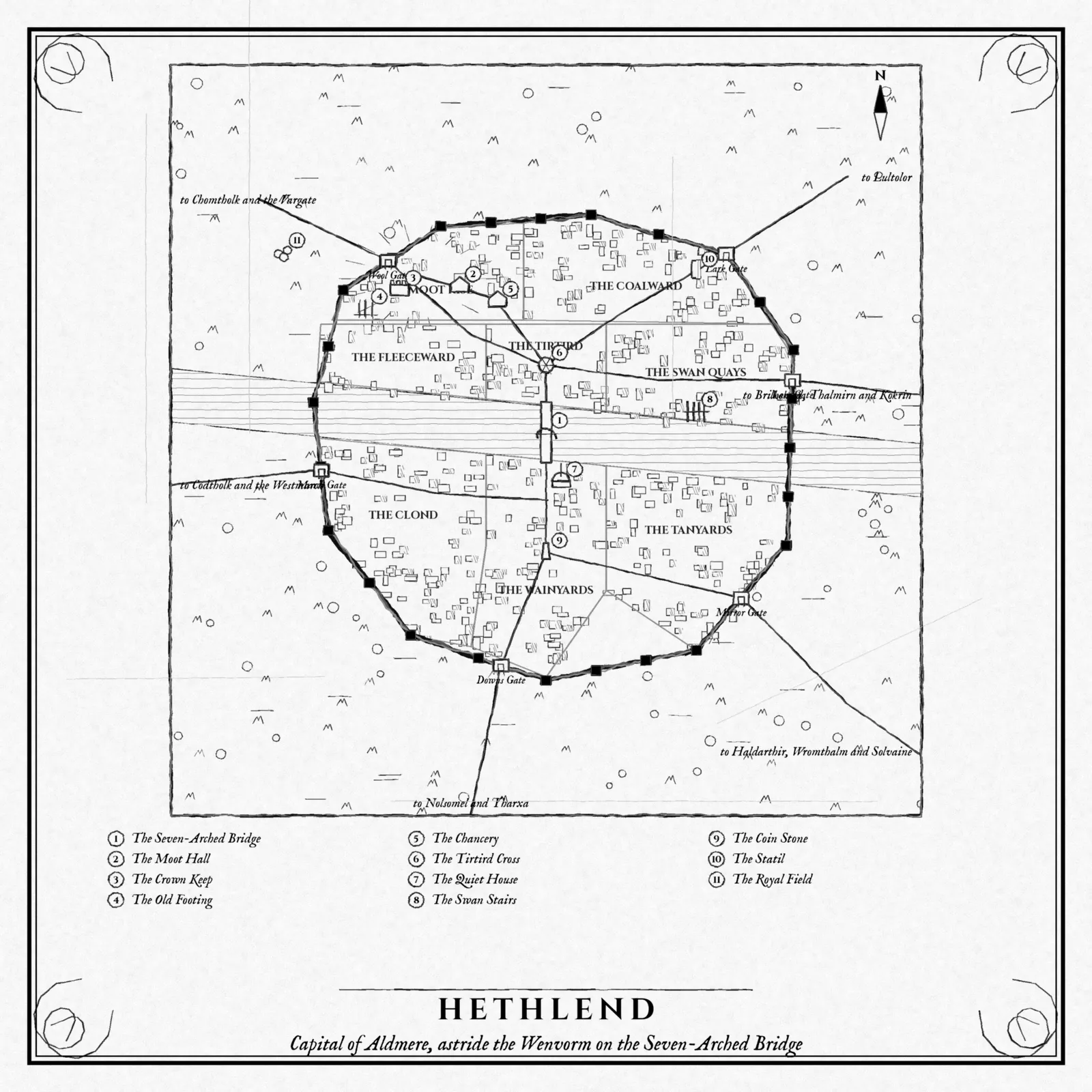
Capital of the Kingdom of Aldmere · about 70,000 people
Come up the Nolsomel road in late summer and you will smell Hethlend before you see it: malt from the brewhouses, hops on their poles in the river meadows, and, when the wind swings east, the tanyards. Then the road tops a rise, and there lies the city on both banks of the Wenvorm, one gray wall thrown around two halves of a town, and the seven arches of the bridge holding them together. Barges ride at the quays below it. The white specks on the water are the king's swans, and no man may touch them.
Nearer in, carters curse at the Downs Gate and hammers ring from the Coalward across the water. Only the bridge is quiet. People cross it talking low, and nobody whistles.
At a Glance
| Population | About 70,000 inside the walls, and perhaps 15,000 more in the river villages and hop-farms of the Crownlands around it |
| Ruled by | The crown directly: King Hethlarn Tulvard III, the Moot when it sits, the Chancery always. The city's own affairs are run by an elected Bridge-Reeve and the guild reeves |
| Walls | One stone ring about four miles around, enclosing both banks, with six land gates and two chain towers where the wall meets the river |
| Water | The Wenvorm, wells on both banks, and a public cistern on Moot Rise. No one who can help it drinks the river below the tanyards |
| Lives on | The crown's business, river trade on the Golden Road, grain, wool, ale, leather and iron goods, and the tolls of the six crown roads that start here |
| Faith | The Hearthfaith, with seven hearth-houses, one for each Hearth. The Charter of Hearths allows every other faith, and most of them are here |
| Tongues | Aldmeri, written in Hearthscript. Caelvennois among bankers and merchants, Maved in the caravan yards, and Zarvani, Kaishoni and Tharaxi in the Clond |
| Coin | The gold crown and silver mark, minted at the Chancery. For small change, marks are cut into halves, quarters and eighths |
| Known for | The Seven-Arched Bridge, the Moot hall, the Chancery, the king's swans, Hethlend hops, and Sister Tunith's death-hearth |
| Direction | STABLE, under strain |
History in Brief
- Before 178 (local lore): Hethlend was a bridge town between two kingdoms, its north bank looking to Vareth and its south bank to Wessary. The old timber bridge was the one place the two courts met without armies.
- 160s — The Gray Cough sweeps the Heartlands, and Hethlend stands empty three years.
- 178 — The thrones of Vareth and Wessary are joined under Hethmed Tulvard. The tale is that the timber bridge groaned under every pretender and went silent under him.
- 231 — The Hethlend Collapse. The spring flood takes the timber bridge, and three hundred people drown with it, Aldmere's Lord Chancellor among them.
- 244 — The seven-arched stone bridge is finished.
- 352 — King Hethgrul II dies without an heir. The great lords gather here in the first Moot to choose between two cousins. It has met every year since.
- 432 — Hearthking Anoga Wolf-Mother, it is said, walks into Hethlend with a wolf on a rope and walks out with a hundred wagons of grain.
- 622 — Ash from the Cinder Teeth falls on the city, and the sky stays dim for a year.
- 641 — The Charter of Hearths makes worship free. People fleeing Kaishon's Reasoned Purge and Castavar's inquisition begin to settle on the south bank, and the quarter that grows there is still called the Clond.
- 822–829 — The Lords' War. The Westmarch has not trusted Hethlend since.
- 996 — King Hethlarn I is stabbed on the Moot's floor by a Westmarch baron. The king lives; the baron does not. Weapons are banned from the Moot hall.
- 1121 — Hethlarn Tulvard III is crowned in Hethlend at 27.
- 1146 — Prince Hethbael asks his father, before the whole Moot, why Aldmere still pays interest on a loan made in 511.
The Layout
Hethlend is a bridge with a city grown up around it.
Hethlend is a bridge with a city grown up around it. The Wenvorm runs east through the middle, a long bowshot wide, and the Seven-Arched Bridge crosses where two gravel banks face each other. The north bank is the older, higher half, climbing from the quays to Moot Rise. The south bank is flatter, newer and louder, and grew up around the roads to the Westmarch, the Southdowns and Caelvenne. One wall rings both. Where it meets the river, upstream and down, two round towers hold an iron chain that is raised across the water at night. Downstream is east, so the trades the city would rather not smell sit on the eastern side.
Moot Rise. The hill in the northwest quarter is the seat of the kingdom: the Crown Keep on its crest, the Moot hall below it, the Chancery beside that, and the tall town houses of the great lords, which fill when the Moot sits. Caelvenne's ambassador keeps the Lily House here. The streets are quiet, swept and full of clerks. There are only two ways up, the Chancery Steps from the market and the Keep Road from the Wool Gate, and the Crown Wardens watch both.
The Fleeceward. The low ground west of the market, between Moot Rise and the river, is the wool quarter. Chomkel fleeces come down the Chomtholk road to the Wool Gate, and they are weighed, graded and sold in long timber halls that smell of lanolin and wet sheep. Fullers, weavers and the dyers of the better colors work behind the halls. Its guild reeves are the loudest Mootmen in the city.
The Tirtird. The north bridgehead is one great sloping square and the lanes that feed it. The name is the Aldmeri word for "market," and nobody has ever called it anything else. Brother Ash preaches here when he is in the city, the Gray Choir sings here when it comes south, and the king's heralds read the Moot's new laws from here. By day the noise never stops. By night the square belongs to the watch and the rats.
The Coalward. The broad northeastern quarter, climbing from the market toward the Lark Gate, is the city's forge ground and its poorest. Smiths, nailers, coopers and day laborers live stacked in timber houses three and four floors high. The name comes from the coal carts that grind up from the quays all day. A house whose hearth goes cold in winter gets a coal from its neighbor that same night.
The Swan Quays. East of the bridge along the north bank lie the wharves: stone quays, warehouses, crane-wheels, and the moorings where Drift barge-towns tie up when they pass. This is the working end of the Golden Road, where grain goes out and wine, glass and silk come in. The quays smell of tar, fish and wet rope, and the quay-masters know every barge by its patching. Pell of the Drift knows which of the quay-masters take bribes.
The Wainyards. The south bridgehead is Hethlend's front door. Inns, stables, carters' yards and the Qaflan caravan grounds fill it from the bridge to the Downs Gate. It is loud, merry and a little crooked, and its inns are the best place in the kingdom to hear news before the Chancery does.
The Clond. West of the Wainyards on the south bank is the strangers' quarter, and its name is the Aldmeri word for "stranger." It began after the Charter of Hearths in 641, when those in flight were given land outside the old south wall, and the wall was later moved out to take them in. Today it houses Kaishoni who kept their household Kin, Castavari who left the Berrode, Zarvani traders, Ember Pilgrims and Bound runaways from Tharax. There are more tongues to a street here than anywhere west of Solvaine.
The Tanyards. The southeastern quarter, downstream of everything, is where the stinking trades work: tanners, curriers, glue-boilers, dyers of the cheap colors, and the slaughterhouses. The brewhouses are here too, and they buy Hethlend hops from the river farms outside the Mirror Gate. The Tanyards pay well and age people fast, and they are proud of both.
Landmarks
The Seven-Arched Bridge. Finished in 244 to replace the timber bridge the flood took in 231, it carries the city and the crown roads over the Wenvorm on seven stone arches.
The Seven-Arched Bridge. Finished in 244 to replace the timber bridge the flood took in 231, it carries the city and the crown roads over the Wenvorm on seven stone arches. The old bridge, they say, groaned under any pretender and went silent under Hethmed Tulvard, and the stone one keeps the habit: no king of Aldmere is truly king until he has walked its seven arches alone at dawn and the bridge has not spoken. Every king has done it. Prince Hethbael has not yet. Nobody whistles on it, because the arches count the notes and the seventh belongs to the Quiet Hearth. Boys catch bridge crayfish from the cutwaters.
The Moot Hall. In this long hall on Moot Rise the great lords and the burgher-reeves make Aldmere's law. Weapons have been banned inside since 996, when a Westmarch baron stabbed King Hethlarn I on its floor, and every lord leaves his sword on a rack by the door. The clerks say a burgher-reeve of Chomtholk has slept beneath the hall since the debate of 352, and that the Moot's power ends if he wakes, so they knock three times on the floor before every sitting. Moot owls are said to roost in the roof. On Moot day every town in the kingdom sends a loaf, and the poorest man present cuts it.
The Crown Keep. The king lives in a square old tower on the crest of Moot Rise, with a newer hall built against its south side. It is plain by any measure but Tharax's. King Hethlarn keeps his rooms on the second floor, over the kitchens, because they are warm.
The Old Footing. The Crown Keep stands on black stone. When the cellars were deepened, masons found courses of the Builders' cast stone beneath the Vareth-era foundations and left them where they were, because nothing in Aldmere is as strong. The Chancery's clerks call it "the only part of the Keep older than the debt."
The Chancery. A plain stone building beside the Moot hall, with barred windows and a rookery of clerks. It keeps the kingdom's books, the Moot's rolls, the tax rolls of every shire, and the mint where crowns and marks are struck. Lord Chancellor Tuvith Ownirel works in a corner room on its top floor, and its lamps burn later than any others in the city.
The Tirtird Cross. A stepped stone pillar topped by seven small bronze flames stands in the middle of the market. The crown roads are measured from its lowest step, so every milestone in the kingdom counts its distance to this spot. Laws are proclaimed from its steps, and debts are paid before it when the payer wants witnesses.
The Quiet House. The death-hearth of the Quiet Hearth stands at the south foot of the bridge, at the end of the seventh arch: a low gray building with a banked fire that is never let blaze, and a long room of beds for the dying. Sister Tunith keeps it. Those fleeing Kaishon's purges and Castavar's inquisition come here first.
The Swan Stairs. Broad stone steps lead down to the water on the north bank, east of the bridge. The royal swan-keepers launch their boats here, and by law every swan on the Wenvorm is the king's. A swan seen here with its neck turned toward the city means the king will hear bad news, and the keepers are asked about it several times a day.
The Coin Stone. A rough standing stone marks the crossroads in the middle of the Wainyards, where the roads to the Westmarch, the Southdowns and Caelvenne part. The Qaflan call it a shrine of the Road Spirit, and merchants of every faith leave a coin in the hollow at its foot before a journey.
The Statil. The tallest tower on the wall stands at the northeast angle above the Coalward and houses the Crown Wardens who hold the city. Its name is the Aldmeri word for "watchtower." A beacon on its roof can pass word to the signal fires on the hills toward Lultolor and the Northmere.
The Royal Field. The king's field is a walled strip of river meadow outside the Wool Gate, plowed by Wenvorm oxen and sown with Crown wheat. On the 1st of Chomark, New Year's Day, the king cuts the first furrow of the year here, while every village reeve in Aldmere cuts one at home.
Government, Law and the Watch
Hethlend is the crown's city. The king holds it directly, with no lord between him and the townsfolk, and the Chancery's clerks gather its taxes.
Hethlend is the crown's city. The king holds it directly, with no lord between him and the townsfolk, and the Chancery's clerks gather its taxes. The Moot meets here from the 1st of Halshul, once the harvest is in, and sits until its business is done, which of late means the snow. While it sits, the city fills with several thousand lords, servants, petitioners and pickpockets.
The day-to-day running of the city belongs to the townsfolk. Each guild elects a reeve, and the guild reeves elect a Bridge-Reeve for three years. The Bridge-Reeve keeps the bridge, the walls, the gates, the markets and the watch, and sends the city's burgher-reeves to the Moot. The present Bridge-Reeve is a Fleeceward wool merchant, and she and the Lord Chancellor dislike each other with great courtesy.
The law is the Moot's law, heard by the crown's judges in the Law Hearth's hearth-house beside the Moot hall. Courts sit on Law-day, Tuvad, and never in the Accord Days. Thieves are fined or pilloried, and killing one of the king's swans costs a crown a bird. Banishment is common and cheap: the sentence is read at the Tirtird Cross, and the banished man is walked across the bridge and out the Downs Gate.
The Crown Wardens keep about fifteen hundred men in the Statil and on Moot Rise, and they answer to the crown alone. The city watch is another body, a few hundred guildsmen serving in turns under the Bridge-Reeve. They shut the gates at dusk and raise the river chains, and they are better at noticing trouble than stopping it.
Trade and Work
Hethlend lives by standing in the middle.
Hethlend lives by standing in the middle. Grain comes to it from every shire and leaves by barge for Caelvenne, and Chomkel wool is weighed in the Fleeceward before it goes east. The crown roads bring Westmarch iron, Southdowns yew, Northmere eels and Qaflan caravans. The Golden Road brings glass, silk and wine up from Solvaine.
The city's own trades are plain ones: ale and mead, leather, iron tools and nails, wool cloth, rope, barrels, and longbows of Downs yew for the Crown Wardens. Its guilds are strong and quarrelsome. After the brewhouses, the Chancery puts more people to work than anyone, and a clerk's post there is the best living a lettered Aldmere boy or girl can get without leaving for Solvaine.
Markets. The Tirtird is open every day but Quiet-day. The wool sales in the Fleeceward are held on Harvest-day, Tengant, each week from Serleck to Wrunim. Horses and oxen are sold outside the Downs Gate on Road-day, Totid.
A short price list (in the Tirtird and the Wainyards, 1146):
| Item | Price |
|---|---|
| A day's labor on the quays | 1 mark |
| A bed and a hot meal at a Wainyards inn | 1 mark |
| A loaf of Crown wheat bread | an eighth of a mark |
| A jug of Hethlend ale | an eighth of a mark |
| A smoked mere eel | a quarter mark |
| A pair of shoes | 3 marks |
| A Downs yew longbow, unstrung | 10 marks |
| A Heartland gray horse | 3 crowns |
| A Wenvorm ox | 5 crowns |
| An otter-lined cloak from Wromthalm | 6 crowns |
A crown is worth twenty marks. Leusores pass everywhere at the Chancery rate.
Daily Life
Food. Bread is Crown wheat, even for the poor, and ale is drunk at every meal.
Food. Bread is Crown wheat, even for the poor, and ale is drunk at every meal. The river gives Wenvorm trout to those who can pay for it and eels to those who cannot. A Coalward household eats meat twice a week. A Moot Rise household eats it twice a day.
Dress. Everyone wears wool: undyed or brown for laborers, blue and green for guild families, red for lords. An otter-lined cloak means great wealth. Caelvennois silk is worn on Moot Rise and mocked everywhere else.
Housing. Houses are timber frame and plaster on stone footings, three or four floors high where the city is crowded. Thatch has been forbidden inside the walls since a fire nobody can date and everybody fears, so roofs are slate or tile. Every house keeps a coal burning overnight, and no one lives in a new house until a coal has been carried to it from a neighbor's hearth.
A day's rhythm. The gates open at first light, the Chancery works until dark, and the Wainyards taverns stay open until the watch shuts them. Quiet-day, Tunnath, is the day of rest. Shops close, the bridge empties, and families eat together.
Entertainment. Tumblers in the Tirtird, dice everywhere, archery butts outside the Downs Gate, and boat races on the Wenvorm in summer. The best-loved cart-play every autumn is the comedy of the clerk who tries to count the stars for the tax rolls.
Festivals. - First Furrow (1st of Chomark, New Year's Day). The city walks out the Wool Gate to watch the king plow the first furrow in the Royal Field. - Wemm's Night (the first full moon of Larrel). The Crown Wardens' Southdowns longbowmen shoot at the moon from the Statil's roof, and are fined for it every year. - Harvest Home (30th of Tengant). The last sheaf is carried in from the Royal Field and set on the Tirtird Cross. - Moot day (1st of Halshul). The Moot opens. Every town's loaf arrives at the hall, the poorest man present cuts it, and the king eats last. - Quiet Hearth night (the longest night, 6th of Tulront). The city sits in the dark for an hour with its hearths banked and names its dead aloud. Sister Tunith keeps the Quiet House open all night.
Faith
Hethlend keeps the Hearthfaith in seven hearth-houses, one for each Hearth: Home in the Fleeceward, Harvest by the Tirtird, Forge in the Coalward, Road in the W…
Hethlend keeps the Hearthfaith in seven hearth-houses, one for each Hearth: Home in the Fleeceward, Harvest by the Tirtird, Forge in the Coalward, Road in the Wainyards, Healing near the Swan Quays, Law beside the Moot hall, and the Quiet Hearth's death-hearth at the foot of the bridge. Their Hearth-keepers serve part of their time, like every Hearth-keeper in Aldmere, and worship is a practical thing. People bring bread to the Harvest hearth after a good sale, and nails to the Forge hearth before a hard job.
The Charter of Hearths allows every other faith. The Chancery is full of quiet Ledger-followers who read their accounts every seventh night. Caelvennois merchants keep the Radiant Iévaine in a small chapel in the Clond, and Zarvani traders tend a fire in a fire-house nearby. Drift bargemen tie knotted cords to their boats for the Drowned Court, Ember Pilgrims sleep in the Quiet House, and a few hundred Gray Choir singers now sing in the Tirtird at dawn.
Crime and the Underside
Most of Hethlend's crime is small: pickpockets in the Tirtird, short weights in the wool halls, dice with shaved corners.
Most of Hethlend's crime is small: pickpockets in the Tirtird, short weights in the wool halls, dice with shaved corners. The Wainyards have a trade in stolen goods that follows the caravans out of the city before anyone can trace it. The Swan Quays have smuggling, because the Drift has never paid a tax to anyone and sees no reason to begin at Hethlend.
Two things are larger. The first is the Quiet Office. Caelvenne's spies are in the Lily House, in the Chancery's lower rooms, in the banking houses and in at least one lord's household on Moot Rise, and the Crown Wardens have never caught one. The second is the trade in people. Bound runaways from Tharax, heretics from Castavar and Kaishoni who kept their Kin all arrive with enemies behind them, and there are men in the Clond who will sell a name to the Tyrthas or the Office of Truth. Sister Tunith knows several of them by sight and has never said so to anyone.
The poor of the Coalward and the Tanyards are loyal to the king and angry about the price of bread. In a bad year they could be a mob by the afternoon.
People of Note
- King Hethlarn Tulvard III (52), "the Steady," who lives in the Crown Keep, plows the Royal Field every New Year's Day, and takes a week over every decision.
- Prince Hethbael Tulvard (24), the crown prince, who has not yet walked the seven arches alone, and has said before the Moot what he thinks of his father and of Caelvenne.
- Lord Chancellor Tuvith Ownirel (61), who runs the Chancery from its top floor and knows the debt to Farisel to the mark.
- Sister Tunith (38), priestess of the death-hearth, whom the poor of Hethlend call mother.
- Duke Minthor Durift (47), who comes for the Moot and leaves the day it rises.
- Brother Ash (45), the Ember Pilgrim, who preaches in the Tirtird when his road brings him through.
- Caelvenne's ambassador, who keeps the Lily House on Moot Rise and sends Ienvaune pastries to the Chancellor.
- Wenith the Bridge-Reeve (wenith, "hope"), a Fleeceward wool merchant in her second term, who thinks the Chancery should mind its own books.
- Hilald the Swan-Keeper (hilald, "owl"), master of the royal swans, who counts the birds every morning from the Swan Stairs.
- Codorn the Tanner (codorn, "bracken"), reeve of the Tanners' guild and the loudest voice in the Tanyards, who has sworn to march on the Chancery if bread doubles again.
- Solvil the Innkeeper (solvil, "luck"), who keeps the Seven Coals in the Wainyards and sells what she hears to anyone who pays in crowns.
- Brirlil the Fence (brirlil, "raven"), who buys stolen goods behind the caravan yards and knows which of them belong to the Quiet Office's couriers.
Rumors and Story Hooks
- Prince Hethbael has told three friends he will walk the seven arches alone at dawn on the morning after the Moot rises. Half the city means to be awake to hear whether the bridge speaks.
- Hilald the Swan-Keeper has seen a swan with its neck turned toward the city three mornings running. He has told no one but the Chancellor, and the Chancellor has not told the king.
- A Qaflan caravan captain has waited a week in the Wainyards to see the king about Duke Durift's toll-men at Venei's Throat, and Durift's steward drinks at the same inn.
- The Gray Choir's singers in the Tirtird have begun giving away their plows, and the grain factors are buying them cheap.
- Solvil the Innkeeper swears a Cherüsh rider under a white felt banner stayed one night at the Seven Coals and asked the way to the prince, not the king.
- Somebody has been paying the Chancery's archivists to copy the Vareth marriage rolls from the 600s. The payments came in leusores.
- Masons mending the Crown Keep's cellar found a black-stone passage running under Moot Rise toward the river. The steward bricked it up the same day.
- A Bound family came to the Quiet House last week with a Tyrthas hunter a day behind them, and the man has been seen in the Clond asking for them by name.
Where It Is Going
Hethlend is STABLE, but the strain shows.
Hethlend is STABLE, but the strain shows. The city is safe, fed and busy. Its bridge has stood nine centuries, and its Chancery works. But nearly every weight on Aldmere presses on its streets. The prince and the Clearance want the debt torn up, and the Chancellor knows what that would do to the grain barges. The Gray Choir is walking south, the fleeing keep crossing the bridge, and the Quiet Office sits inside the Chancery, while the king still takes a week over everything. If the old king dies before his son has walked the seven arches, the city will learn how much of its steadiness was his.